

SECOORA Inspires Future Ocean Experts at St. Petersburg Science Festival
On October 18, SECOORA participated in the St. Petersburg Science Festival. Since 2011, the festival hosted on the Bayboro Harbor in St. Petersburg, FL has been inspiring children to get excited about Science, Technology, Engineering, and Mathematics (STEM) activities. It is estimated the two-day event attracts over 25,000 visitors.
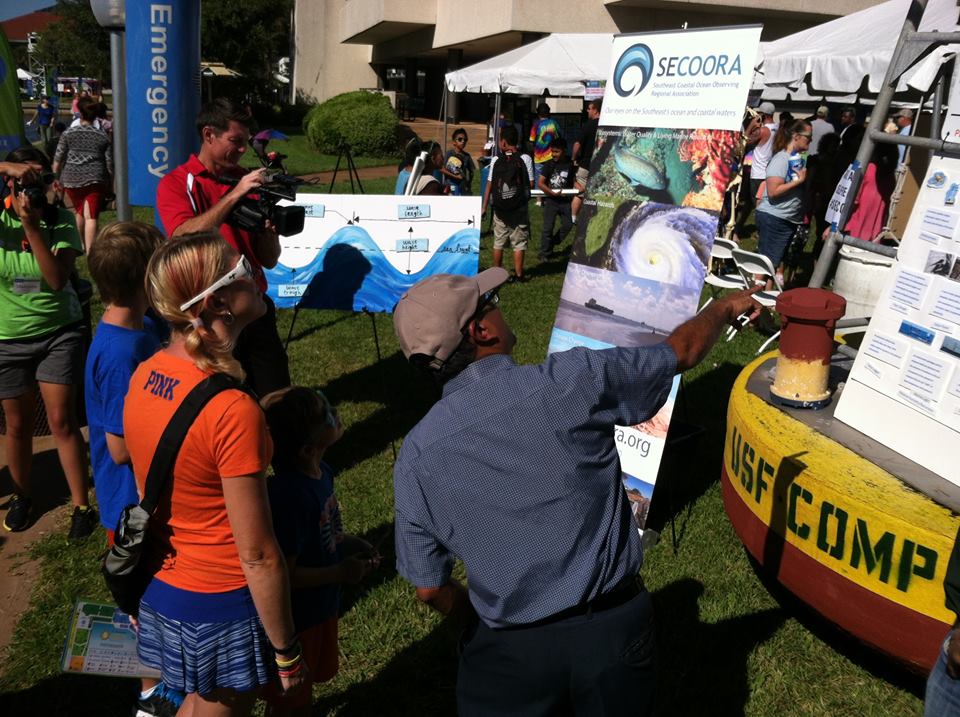
SECOORA, Gulf of Mexico Coastal Ocean Observing Regional Association (GCOOS-RA), and the University of South Florida (USF) teamed together to help cultivate the future generation of ocean observers. The joint exhibit highlighted how to bring real-time ocean and coastal data to the classroom and household.
SECOORA would like to thank Jay Law of USF Coastal Ocean Monitoring and Prediction Systems and Chad Lembke of USF Center for Ocean Technology for providing a buoy and an autonomous underwater vehicle, Murphy, for display. The buoy and glider drew high traffic and media attention. As visitors explored SECOORA’s data portal they were able to relate the data to the piece of equipment.
WTSP/CBS produced a web story based on our collaborative exhibit. Click here to view video/ story.
---
All images are property of SECOORA
On October 18, SECOORA participated in the St. Petersburg Science Festival. Since 2011, the festival hosted on the Bayboro Harbor in St. Petersburg, FL has been inspiring children to get excited about Science, Technology, Engineering, and Mathematics (STEM) activities. It is estimated the two-day event attracts over 25,000 visitors.
SECOORA, Gulf of Mexico Coastal Ocean Observing Regional Association (GCOOS-RA), and the University of South Florida (USF) teamed together to help cultivate the future generation of ocean observers. The joint exhibit highlighted how to bring real-time ocean and coastal data to the classroom and household.
SECOORA would like to thank Jay Law of USF Coastal Ocean Monitoring and Prediction Systems and Chad Lembke of USF Center for Ocean Technology for providing a buoy and an autonomous underwater vehicle, Murphy, for display. The buoy and glider drew high traffic and media attention. As visitors explored SECOORA’s data portal they were able to relate the data to the piece of equipment.
WTSP/CBS produced a web story based on our collaborative exhibit. Click here to view video/ story.
—
All images are property of SECOORA
Related news
Abbey Wakely Joins SECOORA as Director of Communications and External Affairs
SECOORA welcomes Abbey Wakely as their new Director of Communications and External Affairs, where she will lead strategic engagement, communications, and external relations to strengthen the organization’s regional impact.

SECOORA Request for Proposals for a Data System Development, Operations, and Maintenance Service Provider
SECOORA seeks a Data System Development, Operations, and Maintenance (DMAC) service provider to act as a strategic partner while maintaining the current SECOORA Data System. Proposals are due to SECOORA by 5:00 PM ET, March 31, 2026.

Plankton Perfect: Using Imagery to Document Microscopic Marine Life
Dr. Enrique Montes is working to understand how plankton respond to changes in the ocean by capturing high resolution imagery with advanced technology. This work is funded by the Marine Biodiversity Observation Network (MBON) to use novel techniques like the Continuous Particle Imaging and Classification System (CPICS).