

Strengthening Ocean Acidification Data
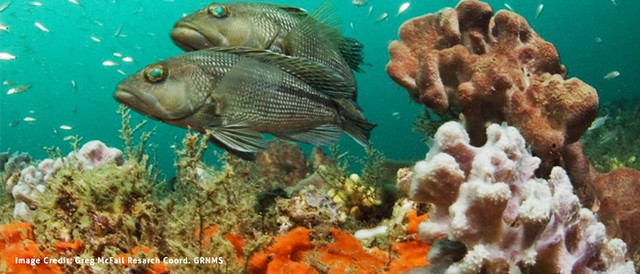
Off of Georgia’s coast is Gray’s Reef National Marine Sanctuary (GRNMS). GRNMS is approximately 17 nautical miles offshore and encompasses 22 square miles of marine protected area that is home to many large invertebrates such as sponges, corals and sea squirts.
In 2013, as part of NOAA’s Ocean Acidification (OA) Program, SECOORA received funds to provide support to the GRNMS buoy. The buoy is maintained by the University of Georgia and is part of international efforts to quantify the effects of OA on the world’s ocean. OA is a global change in ocean chemistry resulting from the ocean's uptake of carbon dioxide (CO2), which is increasing in the atmosphere due to the burning of fossil fuels, land use change and more. It is important to measure OA because the increase in CO2 levels can decrease the ocean’s pH, adversely affecting a variety of organisms, particularly those with calcium carbonate shells or skeletons.
To date, the GRNMS buoy has been recording high resolution monitoring data for seven years. The sensors on the buoy record pCO2, pH, dissolved oxygen, salinity and water temperature. An overall upward trend has been detected for both seawater and atmospheric pCO2. Seawater pCO2 is increasing on average 2.4% per year and atmospheric pCO2 is increasing on average 0.789% per year.1 The near real time data from the buoy is available on SECOORA’s data portal.
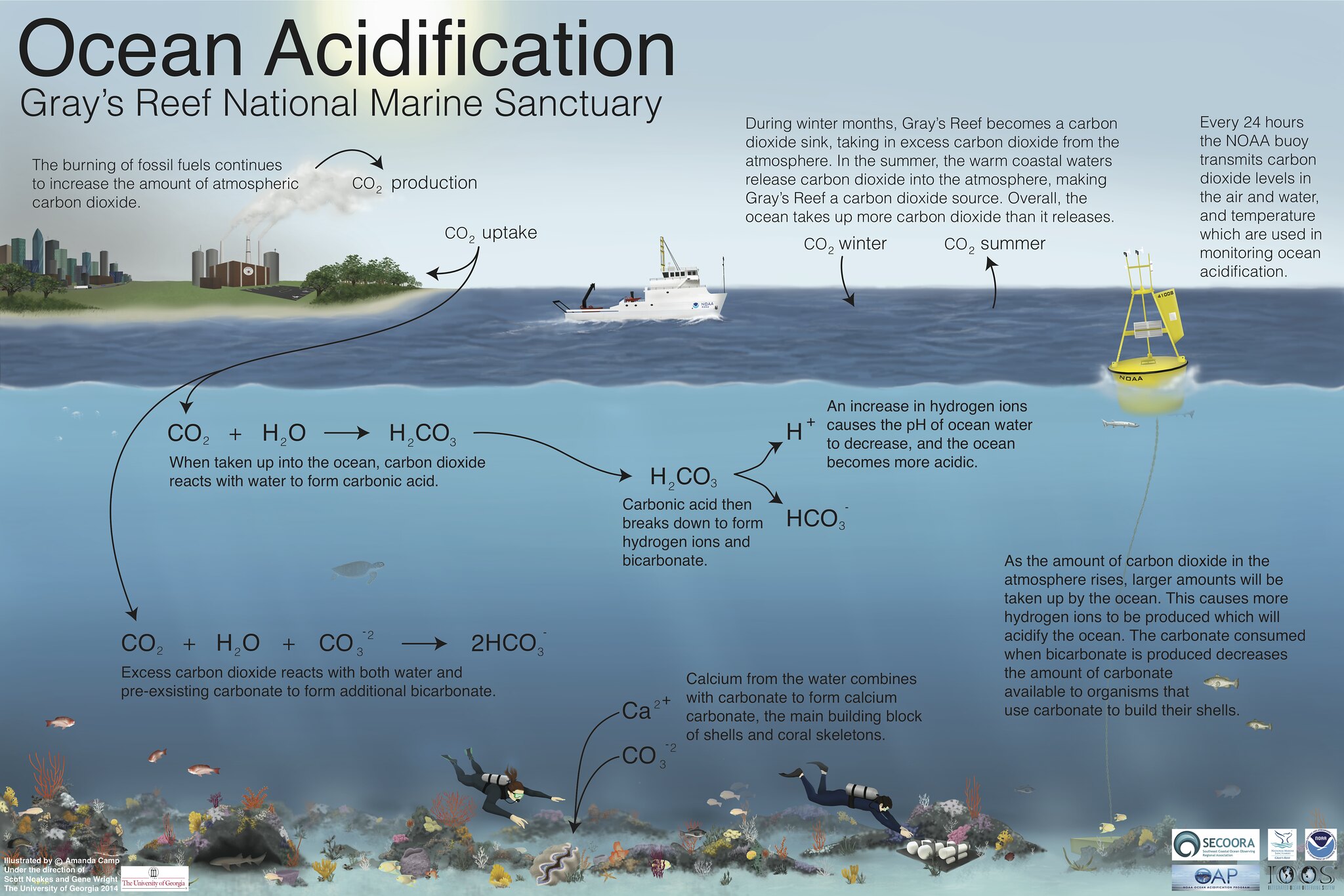
Click image to view full size | Image Illustrated by Amanda Camp
-------
1 https://secoora.org/sites/default/files/webfm/members/documents/IOOS_Progress_Report_Dec2013.pdf
June 26, 2014
Off of Georgia’s coast is Gray’s Reef National Marine Sanctuary (GRNMS). GRNMS is approximately 17 nautical miles offshore and encompasses 22 square miles of marine protected area that is home to many large invertebrates such as sponges, corals and sea squirts.
In 2013, as part of NOAA’s Ocean Acidification (OA) Program, SECOORA received funds to provide support to the GRNMS buoy. The buoy is maintained by the University of Georgia and is part of international efforts to quantify the effects of OA on the world’s ocean. OA is a global change in ocean chemistry resulting from the ocean's uptake of carbon dioxide (CO2), which is increasing in the atmosphere due to the burning of fossil fuels, land use change and more. It is important to measure OA because the increase in CO2 levels can decrease the ocean’s pH, adversely affecting a variety of organisms, particularly those with calcium carbonate shells or skeletons.
To date, the GRNMS buoy has been recording high resolution monitoring data for seven years. The sensors on the buoy record pCO2, pH, dissolved oxygen, salinity and water temperature. An overall upward trend has been detected for both seawater and atmospheric pCO2. Seawater pCO2 is increasing on average 2.4% per year and atmospheric pCO2 is increasing on average 0.789% per year.1 The near real time data from the buoy is available on SECOORA’s data portal.
Click image to view full size | Image Illustrated by Amanda Camp
——-
1 https://secoora.org/sites/default/files/webfm/members/documents/IOOS_Progress_Report_Dec2013.pdf
Related news

News
July 23, 2026
Claire McGrath Joins SECOORA as Program and Development Manager
SECOORA welcomes Claire McGrath as Program and Development Manager, supporting the Southeast & Caribbean Coastal Disaster Resilience Partnership and membership growth.

Florida
July 14, 2026
Spotlight: Mobilizing to Save Florida’s Coral Reefs
Learn how scientists are racing to save Florida's Coral Reef through coral rescue, gene banking, reef restoration, and innovative conservation efforts after disease and marine heatwaves devastated one of America's most important marine ecosystems.
Florida
July 8, 2026
From a Whale’s Song to an Ocean’s Symphony: How AI Decodes Underwater Sound
Explore how SECOORA-funded research is using AI and machine learning to decode ocean soundscapes, detect boat noise, and support coral reef restoration efforts.