

Dr. Greg Dusek, Chief Scientist for The National Oceanic and Atmospheric Administration (NOAA) Center for Operational Oceanographic Products and Services (CO-OPS), will be joining SECOORA for a four-month-long detail as a part of NOAA’s Leadership Competencies Development Program.
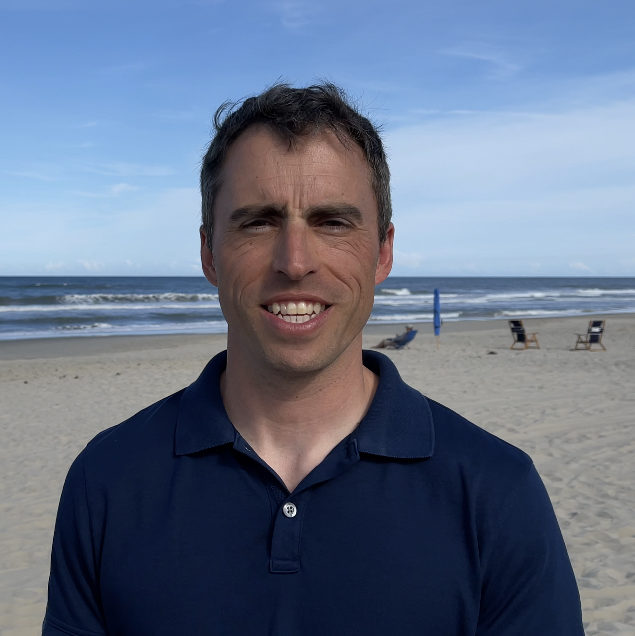
Dr. Dusek earned his Ph.D. in Physical Oceanography from the University of North Carolina at Chapel Hill. Dr. Dusek has worked at NOAA for the past ten years, most recently providing oversight for CO-OPS scientific and technical activities, including the National Water Level Observation Network consisting of over 200 real-time tide gauges. Additionally, Dr. Dusek has been a NOAA lead on topics ranging from coastal hazards to Artificial Intelligence (AI). He recently completed a term serving as the chair of the NOAA AI Executive Committee – where he led the development and coordination of AI activities across NOAA.
“I am beyond excited to have this opportunity to work with the SECOORA team for the next four months. SECOORA has been a tremendous leader and innovator within the coastal ocean community, so I am grateful for the chance to contribute to and learn from Debra and her team.”
Dr. Greg Dusek
Dr. Dusek will be working closely with SECOORA to assist with the development of a strategic plan to transition the Webcams for Coastal Observations and Operational Support project to a sustained national network. As well as initiate the development of a SECOORA modeling strategy to better prioritize funding, challenges with internet protocol, and interfacing with NOAA partners.
Dr. Dusek’s technical expertise will be a huge asset for SECOORA over the next few months. Dr. Dusek lives in Maryland with his wife and four children and when not working he can be found shuttling kids to and from soccer, basketball, or whatever sports activities they have planned.
Related news
SECOORA Is Ready for the 2026 Hurricane Season
Hurricane season is here and SECOORA’s resources are available to help you stay informed. From real-time buoy data and live webcam feeds to ocean gliders and storm surge models, our network of observing systems is ready to support forecasters, emergency managers, researchers, and coastal communities throughout the Southeast.

Species Spotlight: Trichodesmium
Discover the remarkable role of Trichodesmium, a microscopic cyanobacterium that helps fuel life across the ocean. In this Species Spotlight, explore how researchers supported by the Marine Biodiversity Observation Network (MBON) are using imaging technology, genomics, and eDNA to better understand this “shape-shifting” organism and its influence on marine ecosystems, ocean health, and coastal economies.
Charleston Coastal Flood Monitoring: Camera Network and Data Insights
A new story map explores how cameras in Charleston, South Carolina are helping communities monitor and respond to changing coastal conditions, from everyday weather impacts to flooding events. As a rapidly growing coastal city with a major working port, Charleston depends on an accurate understanding of water conditions to support transportation, public safety, infrastructure, and economic activity.