

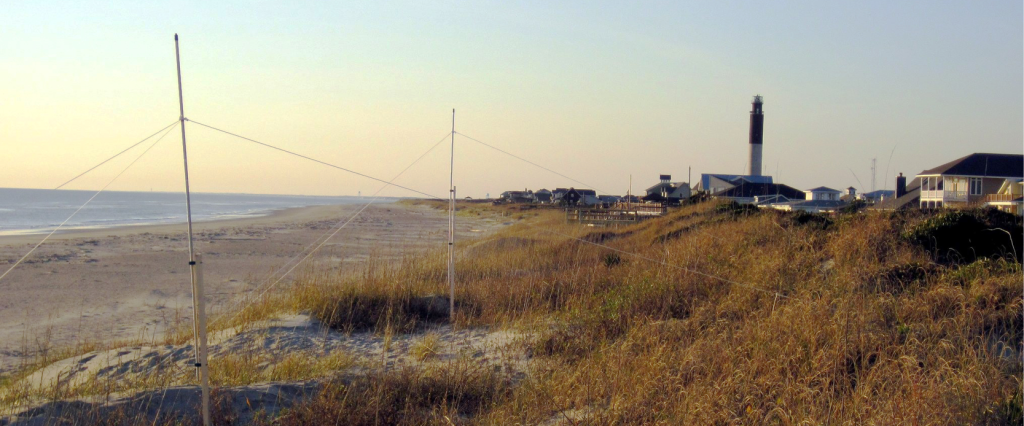
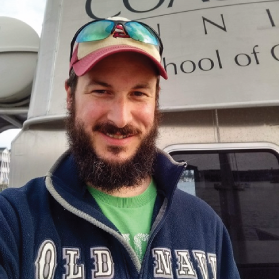
SECOORA is honored to announce the 2020 Data Challenge winner is Douglas Cahl from the University of South Carolina. Douglas will analyze SECOORA High frequency radar (HF radar) data and create a visualization tool to identify eddies.
“Being chosen as a winner of the SECOORA Data Challenge is an honor! This project aims to provide an exciting new web tool showing the location and properties of eddies within SECOORA coastal HF radar coverage areas.” – Douglas Cahl, University of South Carolina (pictured right)
HF radars are land-based systems that measure the speed and direction of ocean surface currents in near real-time. SECOORA supports 16 HF radar in the southeastern U.S.
Eddies are smaller, temporary loops of swirling water that break off from the main current. In the southeast, the eddies break off from the Gulf Steam and help transport nutrients, chemicals, and even larval fish over large distances (more info).
Unlike satellite data, HF radar surface current measurements are available 24/7, rain or shine. Leveraging HF radar’s unique data set within the SECOORA region, an eddy analysis and visualization tool will provide value for both fishermen and researchers.
Keep a look out for the new tool in 2021.
Related news
SECOORA is Hiring a Grants Manager
SECOORA is hiring a Grants Manager to lead grant and subaward management across a four-state coastal ocean observing network. Based in the Southeast US. Apply now.

Meet the new 2026 SECOORA Board Members
SECOORA welcomes three new members to its Board of Directors, effective July 1, 2026 - bringing fresh expertise in marine science, coastal geomorphology, and ecosystem restoration to guide our work across the Southeast.
SECOORA Co-Hosts the 2026 WebCOOS Workshop In Person in La Jolla, CA
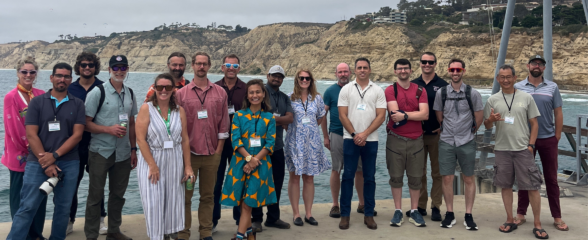
The 2026 WebCOOS Workshop convened in person on July 21-22, 2026 in La Jolla, CA. 45 attendees representing all 11 IOOS Regional Associations and national partners joined this collaborative workshop to discuss webcam-derived coastal products, stakeholder needs, and the network's transition into its next phase under IRA T2.