

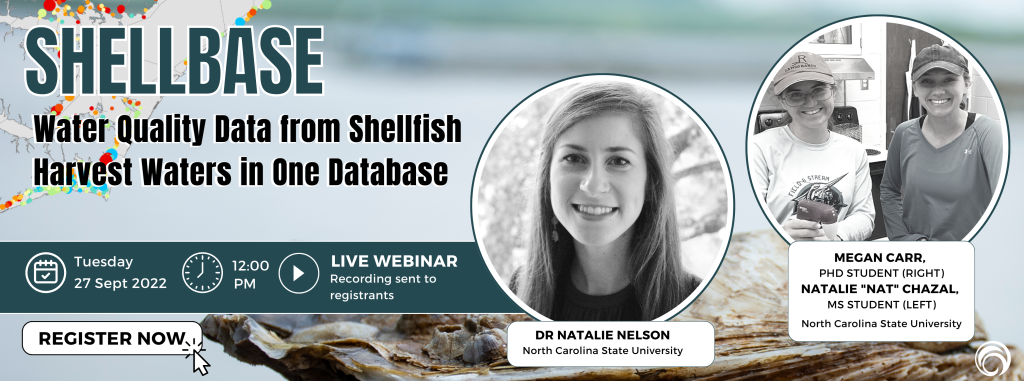
Join SECOORA for a webinar on September 27 at 12:00 PM ET presented by Natalie Nelson, Megan Carr, and Natalie “Nat” Chazal from North Carolina State University. They will be presenting use cases for a database, ShellBase, that compiles long-term records of coastal water quality from shellfish harvest waters in the Southeast.
Abstract
Few long-term monitoring programs with nationally coordinated practices are in place for tracking water quality changes across U.S. coastal waterbodies. In states where shellfish are harvested, regulatory offices collect fecal indicator bacteria concentrations along with additional water quality measurements from coastal waterbodies to understand in which waterways shellfish can safely be harvested for human consumption. Many states have collected these data for decades, creating impressive long-term records of coastal water quality that can potentially fill gaps in existing water quality monitoring programs.
A recent SECOORA-funded project provided resources to compile water quality data collected by regulatory offices from shellfish harvest waters into a unified database called “ShellBase“. In this talk, presenters will outline how ShellBase is organized, and present two case studies demonstrating how ShellBase data can be used to produce management-relevant insights and tools.
About the Presenters
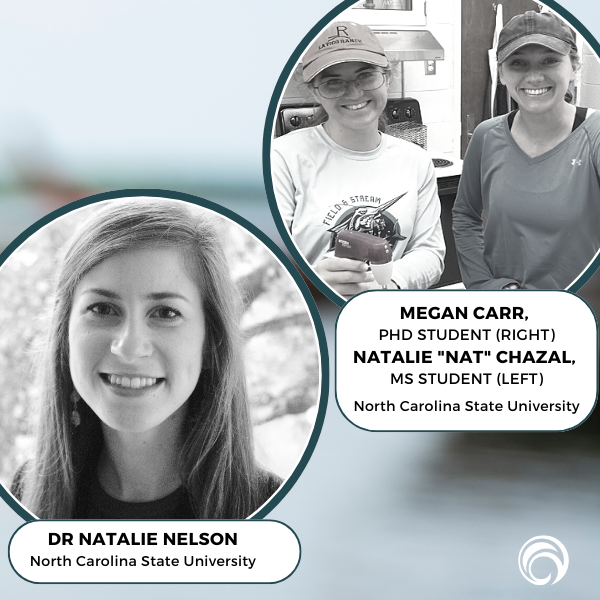
Natalie Nelson is an Assistant Professor in Biological and Agricultural Engineering at North Carolina State University. Her research team takes a data-intensive and management-focused approach to the study of environmental system dynamics, with most of her projects focusing on water quality in estuarine and fresh surface waters.
Megan Carr, PhD student, and Natalie “Nat” Chazal, MS student, will present some of their ongoing work in this talk. Megan is an alumna of the University of Florida, where she received a BS in Environmental Engineering. Nat is an alumna of NC State, where she received a BS in Zoology and Animal Science.
Related news

Above the High Tide: Water Level Sensors on the Front Line
SECOORA's Southeast Water Level Network has installed 100+ sensors across the Carolinas, Georgia, and Florida, giving communities real-time flood data.
SECOORA is Hiring a Grants Manager
SECOORA is hiring a Grants Manager to lead grant and subaward management across a four-state coastal ocean observing network. Based in the Southeast US. Apply now.

Meet the new 2026 SECOORA Board Members
SECOORA welcomes three new members to its Board of Directors, effective July 1, 2026 - bringing fresh expertise in marine science, coastal geomorphology, and ecosystem restoration to guide our work across the Southeast.