

Reinventing the eDNA Wheel: Next-Generation Biodiversity Monitoring
Scientists from MBARI, NOAA AOML, and USGS are using environmental DNA to detect marine life from a single water sample. Learn how long-term MBON time series, autonomous samplers, and machine learning are shaping the future of biodiversity monitoring.
By Zoraida Díaz
Idiomatically, “reinventing the wheel” means needlessly replicating what has already been achieved. Undaunted, science keeps chipping away at that wheel’s rough edges, reinventing it again and again over six thousand years. In one of its most modern iterations, NASA engineered a new kind of wheel for its Mars rovers using a nickel-titanium alloy that deforms around obstacles: a wheel that is no longer rigidly round—a remarkable reinvention.
In ocean observing, the use of environmental DNA (eDNA) to decipher the ocean’s secrets rolls forward with implications as vast and far-reaching as those of that earliest wheel. In just seven decades, from the discovery of DNA’s double-helix structure in 1953 to eDNA’s expanding use in ocean monitoring networks, bold reinvention is reshaping our understanding of marine life.
eDNA is broadly defined as all DNA present in the environment, including whole single-cell organisms like bacteria and trace DNA left by organisms such as fish, marine mammals, or corals.
Dr. Francisco Chavez, Senior Scientist at the Monterey Bay Aquarium Research Institute (MBARI), describes eDNA as a kind of forensic tool to solve crimes, with intrinsic limitations: “If there’s a crime committed in the room, they try to find residues of the suspect, which they then match against the bank of suspects in Interpol or the FBI.” Similarly, eDNA collected from the ocean or freshwater ponds, lakes, and rivers is matched against species listed in databases.
“If the suspect is in one of those lists, you’ll find him,” says Chavez, “but if he’s not, you won’t.”
And therein lies one of the conundrums of using eDNA to monitor biodiversity: an environmental filter can capture genetic traces from every organism in a water sample, but we can only identify what we’ve already cataloged. Linking a sequence to a living organism requires matching its molecular signature against reference libraries that remain vastly incomplete.
Scientific estimates suggest 2.2 million eukaryotic marine species exist (plants, animals, fungi, and protists). Add bacteria, archaea, and viruses, and species counts climb by millions. Yet the World Register of Marine Species (WoRMS) records roughly 250,000 accepted marine species—one-third added in the last 50 years alone. Of those, microbes account for fewer than 1 percent, because microbiologists could name only organisms they could coax to grow on Petri dishes or in liquid culture.
In the mid-1980s, microbiologist and biochemist Norman Pace upended this paradigm by pioneering culture-independent gene sequencing. Pace extracted genetic material directly from natural environments and targeted the 16S rRNA gene—a universal genetic marker shared across prokaryotic life (bacteria and archaea).
The integration of PCR (polymerase chain reaction)—which acts like a molecular Xerox machine, replicating a tiny piece of code millions or billions of times—finally gave sequencing machines enough signal to identify uncultivated species. Suddenly, 99 percent of unknown organisms were waiting to be deciphered, and the coming deluge of data demanded a new generation of sequence databases.

qPCR and Metabarcoding

A landmark 2008 project led by Gentile Ficetola at the Université Savoie Mont Blanc in France showed that unseen organisms could be detected through the genetic particles they shed in freshwater ponds, specifically from the invasive American bullfrog (Lithobates catesbeianus). Then, in 2011, University of Notre Dame researchers David Lodge and Christopher Jerde pioneered eDNA filtering techniques to track invasive Asian carp in North American waterways. These developments launched the modern field of eDNA-based conservation biology and environmental monitoring.
To classify marine life via eDNA, researchers rely on two main techniques: targeted qPCR (quantitative polymerase chain reaction) to detect specific genetic signatures, and metabarcoding to profile broad communities—from microbes to whales—in a single assay.
“qPCR allows you to get a percentage of reads,” explains Dr. Chavez, “you don’t know how much of what you have is there in the water—it’s all relative.”
qPCR is now used routinely to aid in identifying species of concern, including invasive and endangered species, quantifying rare species such as North Atlantic right whales, tracking changes in commercially important fish stocks like Atlantic cod, running automated diagnostics on subsea platforms in real time, and measuring DNA concentrations of harmful algal blooms and beach pathogens, as well as beneficial algal blooms that support entire oceanic food chains.
Metabarcoding is like scanning product barcodes in a shopping cart to generate an inventory list. In nature, short sections of a genome serve as genetic “barcodes”— such as the 16S rRNA gene for microbes, 18S for phytoplankton, COI for invertebrates, and the 12S gene for vertebrates. After researchers extract total DNA from a water sample, target primers bind to regions flanking these barcode genes, allowing PCR to make millions of copies. High-throughput sequencing reads the barcodes, and bioinformatic software then searches massive digital reference libraries for matching species.

New Repositories, Storage Headaches
Genomic databases like GenBank—funded by the U.S. National Institutes of Health in 1982—quickly transitioned from storing individual gene fragments of a few thousand base pairs to hosting the first complete genome of a self-replicating organism, Haemophilus influenzae, in 1995. At the Institute for Genomic Research (TIGR), Craig Venter and Hamilton Smith sequenced the 1.83 million base-pair genome using the pioneering whole-genome shotgun sequencing technique.
Instead of amplifying a single gene through PCR—akin to finding needles in a haystack—shotgun metagenomics shatters all the genetic material in a water sample into millions of random fragments. Sequencing machines read the fragments simultaneously, while powerful algorithms reassemble the puzzle into reconstructed genomes.
In the early 2000’s, Venter took the novel approach out to sea on a multi-year global ocean voyage aboard the Sorcerer II. The venture identified over 1,800 candidate bacterial and archaeal species and discovered over 6.12 million protein-encoding genes, more than doubling the world’s known protein tally.
The voyage marked a milestone for marine biology, showing that shotgun metagenomics could map ocean microbes at a global scale, later enabling researchers to develop hybrid eDNA workflows.
Today, GenBank alone holds genome assemblies for roughly 2.5 million to 3 million single-celled bacteria and archaea. But because eukaryotes—from seagrasses and corals to pelagic fish and whales—have far more complex genomes, researchers have sequenced high-quality reference genomes for barely a few thousand of the 2.2 million eukaryotic marine species believed to exist. And so, millions of fragments of unassigned sequence lie dormant in genetic repositories—unmatched to any named species because most marine species have no reference sequence—and unlinked to registries like WoRMS
Dr. Mark McCauley, a Research Biologist at the United States Geological Survey (USGS), leads a global team of researchers curating 25 years of scattered eDNA studies that used different machines, software, and file formats. Through careful data archaeology, McCauley’s team aims to complete a global “genetic map” by running raw, unprocessed reads through a modern computational workflow. The goal is to resolve sequences into Amplicon Sequence Variants (ASVs)—exact DNA sequences reconstructed from high-throughput marker gene sequencing (such as 16S rRNA)—using statistical modeling to correct machine glitches in earlier bioinformatics methods.
McCauley’s numbers are shocking, showing how manageable and unmanageable the data seem, and how urgent the need for standardization is: while his team has found ~5,000 products, only ~4,000 were unique datasets, and 25% of those have unreleased sequencing files or raw eDNA data locked behind internal drives or private cloud storage. Only a fraction of the ~3,000 available datasets were collected in the open ocean, deep sea, and polar regions, and each multi-terabyte dataset contains millions of DNA sequences.
Seascapes and eDNA Time Series
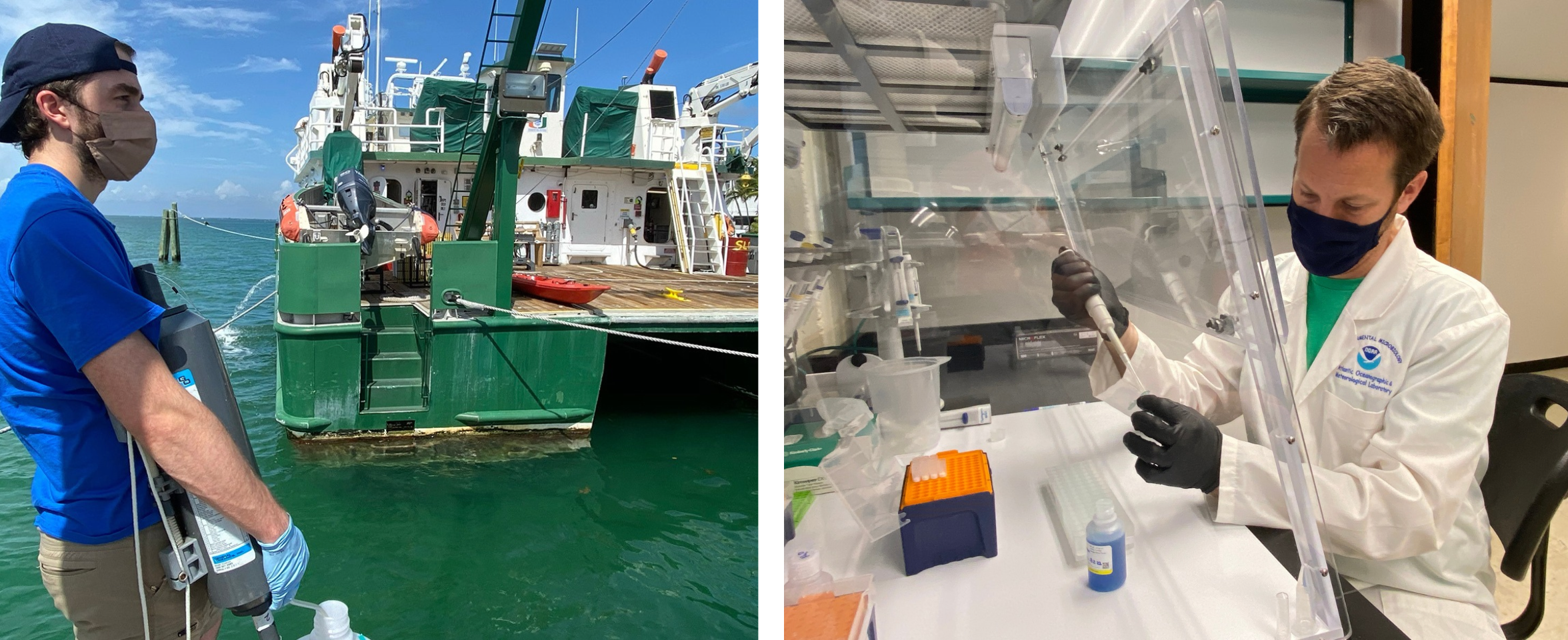
Dr. Luke Thompson, Northern Gulf Institute Research Professor and Co-Principal Investigator of the ‘Omics Program at NOAA’s Atlantic Oceanographic and Meteorological Laboratory (AOML), and Dr. Enrique Montes, an Associate Scientist at the University of Miami’s Cooperative Institute for Marine and Atmospheric Studies (CIMAS) and Director of AOML’s Ecosystem Assessment and Modeling Laboratory, are collaborating as part of an MBON project. Montes and Thompson are going through data from the West Florida Shelf, Florida Keys National Marine Sanctuary, and various deep-ocean locations. The Florida collections represent an 11-year, massive dataset of thousands of water samples collected in traditional ways: researchers filling Niskin bottles with ocean water, then filtering, freezing, and storing samples to later extract eDNA.
“It’s the largest data set I’ve worked with from a single type of environment,” says Thompson, “and we’re adding to that with some newer recurring sampling in Florida Bay.”
Montes and his team are also pursuing the MBON-inspired goal of integrating remote-sensing biogeography, or seascapes, with eDNA markers to predict seasonal planktonic communities that can drive changes in higher trophic levels.
Clear impediments remain to interpreting eDNA in marine environments because it provides a qualitative rather than quantitative assessment.
“You can say an organism is present in the environment,” says Montes, “but you cannot yet say much about its abundance.”
Genomic material also degrades relatively quickly; in warm waters, it degrades faster and may last only a few hours. In colder waters, microbial metabolism is low, extending the organism’s shelf life to a few days.
“You can use hydrodynamic models to look at the water’s circulation,” explains Montes, “and combine that with satellite remote sensing to get a sense of the probability of the organism’s occurrence in that place.”
It is also difficult to distinguish between species that belong in those waters and those that are passing through, making it crucial to record the time, exact location, water temperature, and other oceanographic parameters to contextualize the samples.
Thompson saw one of the first odd examples of eDNA’s forensic capabilities. After getting the NOAA AOML ‘Omics lab up and running around 2020, his team collected water samples from the ocean across the street, off the seawall of the University of Miami’s Rosenstiel School of Marine, Atmospheric, and Earth Science, to test extraction methods. When they sequenced the samples, some of the results were far-fetched.
“We were seeing rainbow trout, smelt, and capelin,” said Thompson, shaking his head. Local experts basically laughed, knowing those fish live in rivers and cold, northern—even Arctic—ocean waters. It didn’t make sense.
“It turned out those fish were the species that the Miami Seaquarium was feeding their whales and dolphins and porpoises just down the road,” added Thompson. “We were seeing traces of fish cuts discarded from the aquarium.”
“What seemed like a negative was really a positive.”
MBON Time Series
“The first time I focused on eDNA was in 2014 when we wrote the first MBON proposal,” says Chavez. The Marine Biodiversity Observation Network (MBON)’s multi-agency pilot projects, funded by NOAA, NASA, and BOEM, were designed to integrate molecular genetics into national ocean monitoring frameworks alongside traditional net surveys and satellite observations. The project began collecting targeted eDNA samples in 2015. Chavez also took samples collected for other purposes from 2008 to evaluate changes further back in time.
Long-term eDNA time series collected by collaborating MBON teams (alongside traditional visual SCUBA diver surveys and trawl nets) in the Monterey Bay and Florida Keys National Marine Sanctuaries showed that eDNA metabarcoding matched or exceeded species counts from traditional surveys. eDNA detected elusive species that routinely escaped nets and visual censuses, and tracked real-time population shifts (from phytoplankton blooms to sardine and anchovy migrations) in response to upwelling events and marine heatwaves—all without capturing animals, processing tissue, or trawling through fragile habitats.
“What the time series captured beautifully was this regime shift from sardines primarily dominating Central California waters to anchovies primarily dominating,” said Chavez.
He shows graphs of species population shifts echoing across taxonomic groups. “They all shift at the same time, which is perplexing, because you would expect the food of the bigger animals to be the first to change—but they change at the same time.”
Dr. Chavez’s time series is ongoing, collecting ocean water from the Mexico-California border to the Oregon-California border and, in coordination with other MBON teams, sampling off Florida, the eastern U.S. seaboard (including the Chesapeake Bay), the Gulf of Maine, the Bering and Chukchi Seas off Alaska, and the Great Lakes. This major effort routinely generates new insights about the nation’s living resources and marine habitats.
When Chavez looks at the Pacific Ocean, he finds it acting in new and unexpected ways, leaving scientists racing to understand how these shifts will affect the marine species we depend on. “A new phenomenon is happening again,” says Chavez, “the North Pacific Gyre Oscillation overlapping with El Niño—this is unusual, as normally you don’t have overlapping climate phenomena.”
“We don’t know if that’s because the world is changing due to human activity or because the climate system is shifting on its own.”
The “eDNA Wheel”
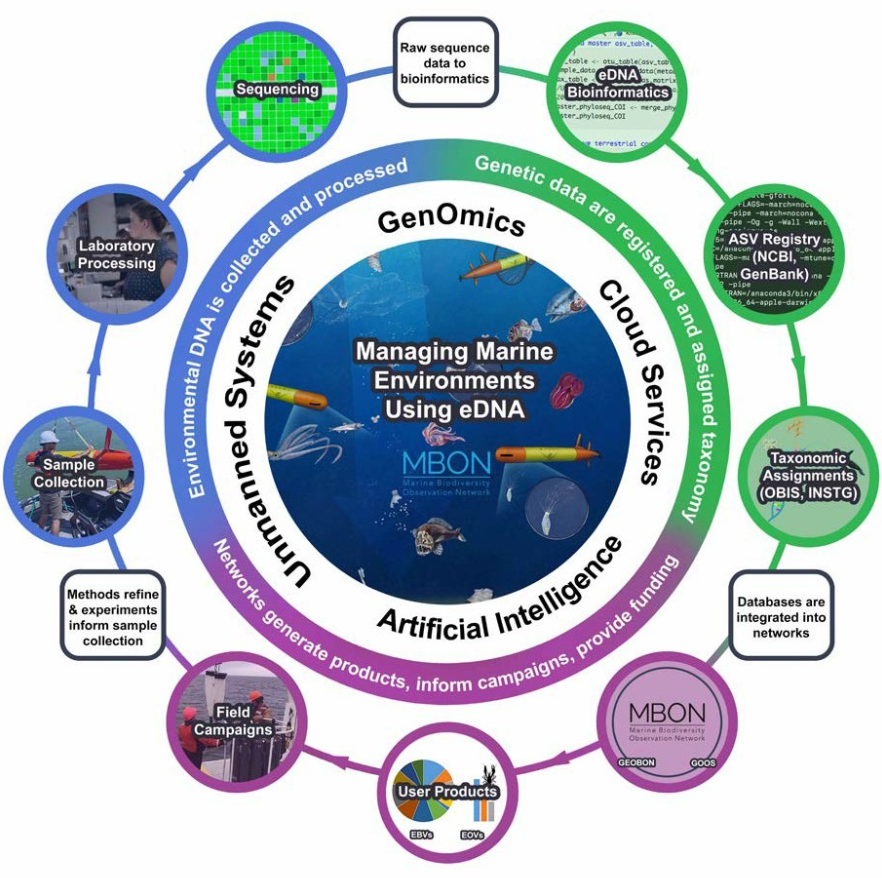
The importance of eDNA monitoring in informing policy came to the forefront in 2021, when the MBON review paper “Observing Life in the Sea Using Environmental DNA” by Chavez and others introduced the “eDNA wheel” framework. It sought to standardize environmental DNA workflows, including sampling, extraction, sequencing, bioinformatics, and use of the Ocean Biodiversity Information System (OBIS) for operational global ocean monitoring. These circular workflows drive innovation at every stage by feeding and improving databases and incorporating feedback from diverse end users of ocean biodiversity data.
That same year, NOAA incorporated eDNA collection into its deep-sea exploration missions aboard the Okeanos Explorer, deeming it an essential tool for modern field oceanography. eDNA monitoring also became the foundation for the Ocean Biomolecular Observing Network (OBON). This UN Ocean Decade-endorsed program collects and disseminates standardized eDNA observations globally and involves many research, government, and private organizations.
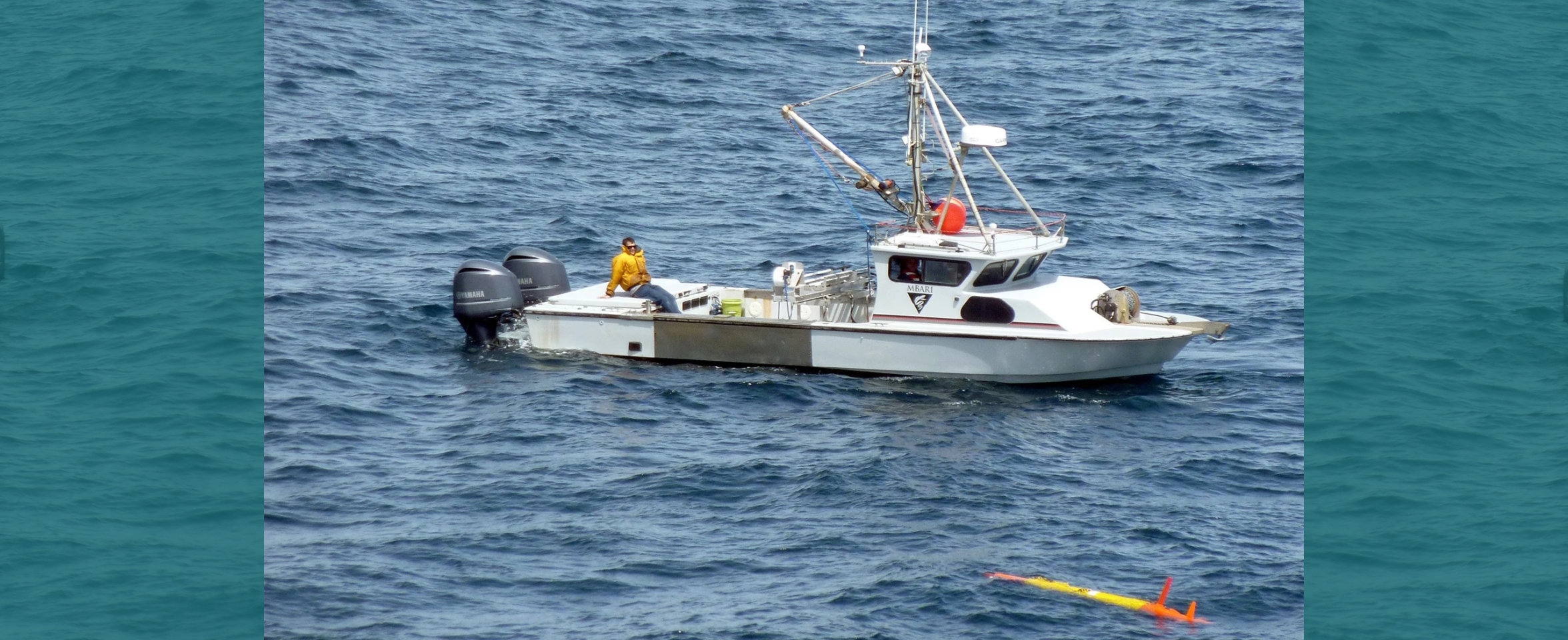
In the last decade, eDNA monitoring has advanced to the point where robotic units, like MBARI’S ESP (Environmental Sample Processor), are deployed on AUVs (Autonomous Underwater Vehicles) or moorings. These autonomous active samplers can filter seawater at pre-programmed depths and times, and preserve the DNA-laden filters, eliminating the need for researchers to collect and filter water samples onboard research vessels.
“There are colleagues from Johns Hopkins University working with our scientists to go all the way,” says Dr. Chavez. “We are working on miniature sequencers that would fit in the vehicles.”
That futuristic iteration would sequence onboard the AUVs and transmit species-detection data back to shore in real time. “That’s like 2001-Space-Odyssey stuff,” says Chavez, “we imagine that it is possible, but not yet happening.”
Other researchers, including Thompson, are also working to improve data-science outcomes by using eDNA data to train machine learning models and strengthen their computational capabilities. For instance, to understand a complex ecosystem—such as predicting fish populations or tracking harmful algal blooms—researchers rely on distinct types of data, including satellite remote sensing data, eDNA from ocean water sampling, fish surveys from trawls, nets, or passive acoustics, and animals tracked over larger distances with satellite or acoustic pinging tags.
Trained on these combined datasets, the models learn the complex biological relationships beneath the surface signals satellites measure (such as chlorophyll-a or sea surface temperature). Because collecting daily eDNA samples across an entire ocean is impossible, the goal is to transfer intelligence from collected eDNA data into different models, each designed for a different practical application.
Once the model learns how genetic, satellite, animal movement, and oceanographic data correlate, it no longer requires continuous eDNA inputs to make accurate forecasts. By leveraging initial eDNA ground-truth data, the AI model can “see” and predict underwater biological dynamics in satellite imagery that would otherwise remain invisible. While satellites offer a continuous vantage point across the global ocean, they can also zoom in on local habitats impacted by fishing or coastal development, as well as track broad climate events like El Niño.
“We do not need to understand all the complex and non-linear processes of the ecosystem to have still some predictive power regarding which organisms and genes may be present at a given time and place,” says Thompson.
“The ‘holy grail’ would be detecting or predicting abundance of fish, beneficial plankton, or harmful algal blooms using just satellite data,” explains Thompson. “This may be impossible for many species, but we are trying.”
Meanwhile, the future of ocean observing is multimodal, combining eDNA with remote sensing (satellite-captured readings of sea surface temperature, ocean color, and salinity), passive and active acoustic monitoring, tracking organism movement, and, arguably, the “new kid on the block,” environmental RNA (eRNA). eRNA provides information on active gene expression, such as physiological stress, reproductive activity, and real-time cellular responses to ocean warming and pollution.

Back to the Future
Although this continuously rolling “wheel” is driving us toward tracking and predicting shifts in marine life across space and time, roadblocks remain. These include incomplete reference databases pairing genetic sequences, taxonomies, and actual specimens (voucher specimens); variable eDNA decay rates in seawater; contamination risks; detection biases; and a lack of standardization across many sampling and bioinformatics workflows.
Chavez, Thompson, and many other researchers linked through MBON, OBON, and other ocean observing networks recognize that one of the most pressing issues for expanding eDNA’s practical applications globally is standardizing protocols for formatting and publishing metabarcoding datasets. Working with government agencies and private groups, these researchers are exploring tools, software, and protocol compilations, such as edna2obis, FAIRe, and BeBOP, that together form an open-access bioinformatics ecosystem designed to streamline eDNA research.
A collaboration with OBIS and GBIF, two globally accessible databases, aims to achieve the ambitious goal of dynamic, near-real-time marine life and biodiversity mapping to inform models, much like the weather data streams coordinated by nations worldwide to produce more accurate forecasts.
At the World Biodiversity Forum in Davos earlier this year, Chavez’s message on eDNA was optimistic: “We’re still trying to get our heads around exactly what we can do with this technique and the best way to use it.”
“Our opportunities are greater than the challenges,” he added, “we have to get to a place where we can measure life in the sea, at the same time and across space scales [that span the local to ocean basins] in the same way that we currently measure the physics and biogeochemistry of the ocean.”
Chavez alludes to advances in measuring temperature, currents, and water chemistry across entire oceans in real time using satellites and sensors, but not yet being able to identify and quantify changes in marine biodiversity—variables and processes that together drive how life will evolve.
Advances in cross-modal machine learning may one day lead to a broader Digital Twin infrastructure where ecosystem forecasts can track shifts critical to business and the well-being of people and ecosystems in real time, permanently relying on real-time scenarios even when physical ground-truth approaches can’t provide observations everywhere all at once.
Enabling eDNA monitoring to map marine life across the globe in real time would give us a more complete picture and different perspectives of the living ocean, reinventing long-held concepts about what is known. Reinventing the eDNA wheel…
“And if we do that,” says Chavez, we will really understand how life in the sea is changing and why.”
This work was supported by the U.S. Marine Biodiversity Observation Network (MBON) co-organized by NOAA, NASA, BOEM, and ONR through the National Oceanographic Partnership Program (NOPP).
Related news
Fish and Ships: Standardizing Marine eDNA Surveillance
Standardization across the eDNA metabarcoding workflow—from field sampling to laboratory sequencing and bioinformatics—is rapidly transforming marine observation.

Meet the Scientist Turning Ocean DNA Into Open Data
Meet Dr. Luke Thompson, the NOAA AOML scientist building open tools that turn ocean eDNA sequences into data anyone can search and use.

SECOORA Receives $25,000 Grant from the Curtis & Edith Munson Foundation to Support South Florida Monitoring
New funding will help sustain coastal monitoring and provide people with the data needed to address challenges facing South Florida’s marine ecosystems.