

Spotlight: Mobilizing to Save Florida’s Coral Reefs
Learn how scientists are racing to save Florida's Coral Reef through coral rescue, gene banking, reef restoration, and innovative conservation efforts after disease and marine heatwaves devastated one of America's most important marine ecosystems.
By Zoraida Díaz
Florida’s Coral Reef, the only living coral reef tract in the continental U.S., stretched over 360 miles and was home to a thriving biodiversity. And then came the diseases and the marine heatwaves. First documented in 2014, Stony Coral Tissue Loss Disease (SCTLD) spread north and south, killing entire coral colonies.
A joint task force of federal and state wildlife agencies, led by the FWC and NOAA’s Fisheries, created the Florida Coral Rescue and Propagation Project in 2018 to combat the spread of SCTLD. Biologists first extracted 102 healthy coral colonies from Key West ahead of the disease’s reach to establish a disease-free gene bank.
The task force partnered with the Association of Zoos and Aquariums to create an instant national network that allowed zoos and aquariums across the country to take in the coral refugees. The FWC Coral Rescue – Coral Monitoring Dashboard shows that between 2016 and 2023, some 2,827 corals from 20 species were removed from the wild and distributed among 24 holding facilities in 14 states. These original corals hold the baseline genetic diversity needed to prevent extinction.
In 2020, The Florida Aquarium’s (FLAQ) Coral Conservation and Research Center replanted some 375 second-generation boulder brain corals (Colpophyllia natans) that had spawned while in the land-based tanks. Repopulation quickly fell short, for in addition to the continued stressors that first affected the reefs decades back, in 2023 a catastrophic marine heatwave wiped out much of both the wild and the replanted corals.
Dr. Andy Bruckner, Research Coordinator for the Florida Keys National Marine Sanctuary (FKNMS), remembers that fateful year and how, as early as February, recorded temperatures were already unusually high. Reef tracts thrive between 21°C and 29.5°C (70°F to 85°F). NOAA issues an ‘Alert Level 1’ warning (Risk of reef-wide bleaching) when water temperatures remain above the regional bleaching threshold of 30.5°C (87°F) for several weeks. In late 2023, NOAA announced a new ‘Alert Level 5,’ which reads like a horror sci-fi movie—Risk of near-total mortality (greater than 80% of corals) / Ecosystem collapse.
“In June, reef temperatures got up to 34°C and 35°C (93°F to 95°F). For the first time ever, we saw water temperatures of 100!” said Dr. Bruckner. He was referring to a water monitoring station in Manatee Bay (northwest of Key Largo) that recorded a sea-surface temperature of 101.1°F (38.4°C) on July 24.
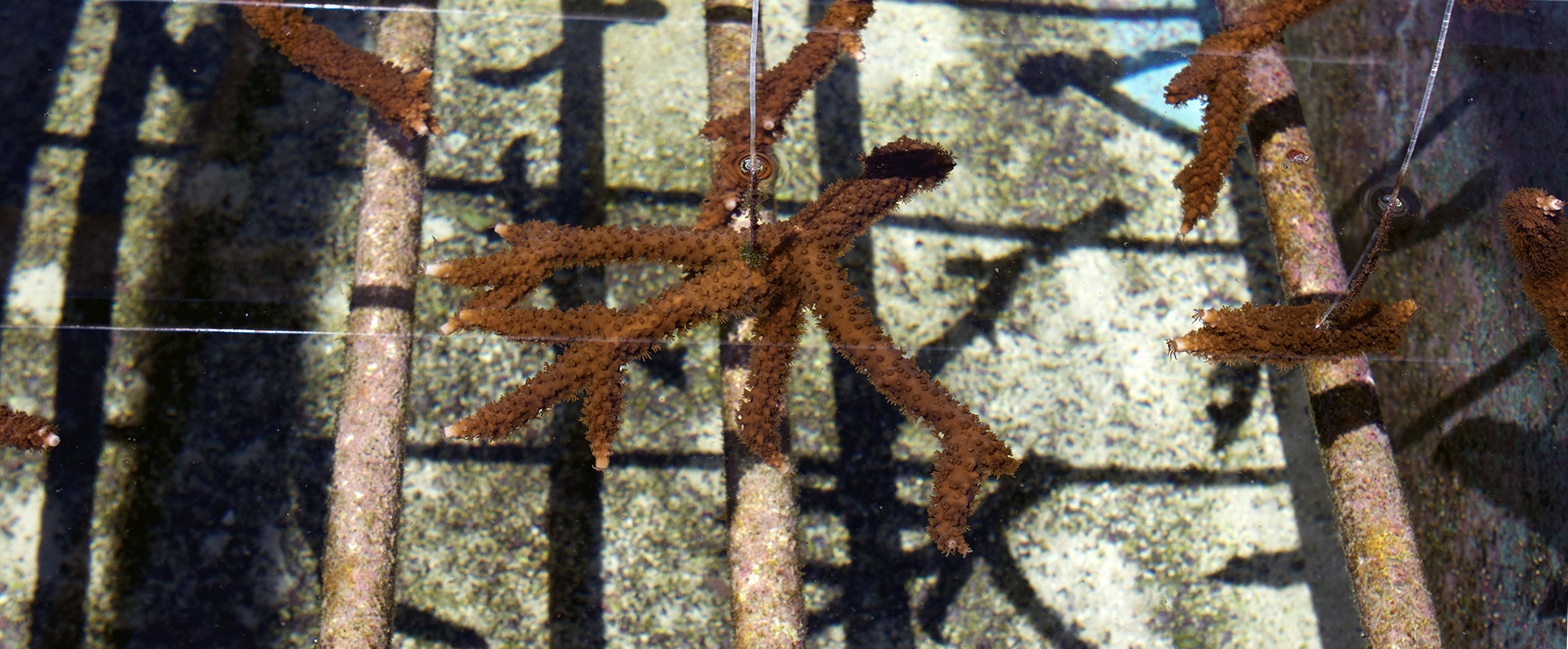
“99.9% of all the staghorn (Acropora cervicornis) and elkhorn corals (Acropora palmata) that we had planted in the middle and lower keys, and 99.9% of all the wild corals—they all died within a couple of weeks,” he said. “We had some survivors in the upper Keys as temperatures were a little cooler.”
Mote Marine Laboratory’s International Coral Gene Bank facility received fragments from those last known staghorn coral survivors in the Dry Tortugas. Mote first began studying the degradation of reef ecosystems in the 90s, launched its formal coral restoration initiative in 2008, and in 2012 pioneered a microfragmentation technique that cuts corals into tiny pieces to stimulate healing and accelerate growth up to 25 times their natural rate.
Dr. Bruckner is one of the lead scientists steering “Mission: Iconic Reefs”, a massive multi-partner NOAA initiative that aims to restore coral cover along seven landmark reef sites in the Keys from its current critical low (1-2%) to a sustainable 25% target along 3 million square feet (0.28 sq km) or the equivalent of 39 regulation soccer fields.
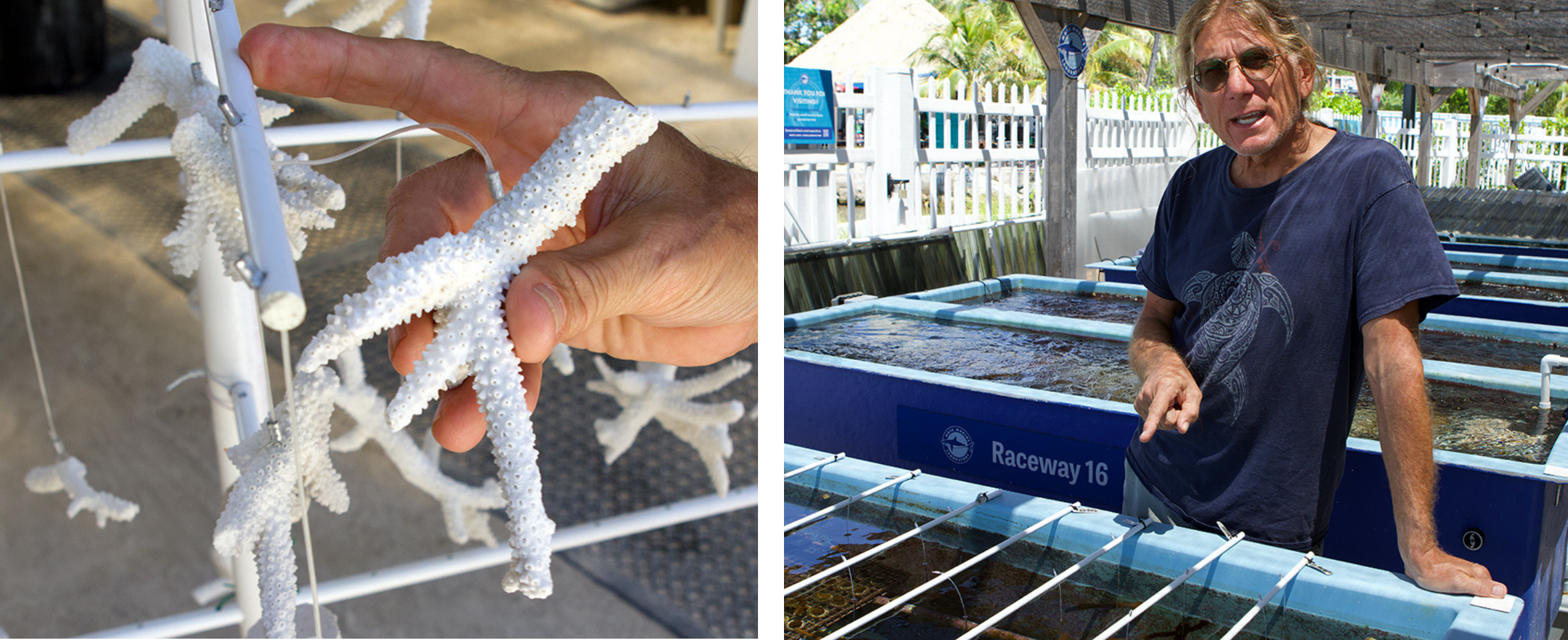
The monumental restoration effort has pushed researchers nationwide to master coral husbandry, focusing on the synchronized spawning patterns of these delicate organisms. In tandem, pioneering institutions like Mote have developed advanced cryopreservation technology—freezing coral sperm at ultra-low temperatures—to create a genetic “time capsule” that guarantees the species’ viability indefinitely.
Scientists have also realized that simply growing corals in land-based nurseries is not enough. Successfully achieving 25% coral cover requires restoring ocean habitats where corals thrive. This means mitigating land-based nutrient pollution, clearing suffocating algae, and reintroducing vital algae grazers—like the Caribbean king crab (Maguimithrax spinosissimus) and the black long-spined sea urchin (Diadema antillarum)—to sustain a healthy reef.
“If we can improve the environment, the corals are more likely to live for the long term,” says Dr. Bruckner.
The U.S. Marine Biodiversity Observation Network (MBON) is co-organized by NOAA, NASA, BOEM, and ONR through the National Oceanographic Partnership Program (NOPP).
Related news
Saving the North Atlantic Right Whale: Underwater Gliders Join the Fight to Save a Species
Meet the SECOORA-funded scientists using underwater gliders and acoustic tech to protect critically endangered North Atlantic right whales.

Dave Wells Joins SECOORA as Ocean Observing Systems Team Lead
SECOORA welcomes Dave Wells as Ocean Observing Systems Team Lead where he will oversee SECOORA's coastal observing system assets and data management.
At the Water’s Edge: Lowcountry Coastlines in a Brave New World
A nor'easter's record storm tide. A stalled tropical storm. Two Lowcountry towns adapting to a new era of flooding, with SECOORA data in hand.