

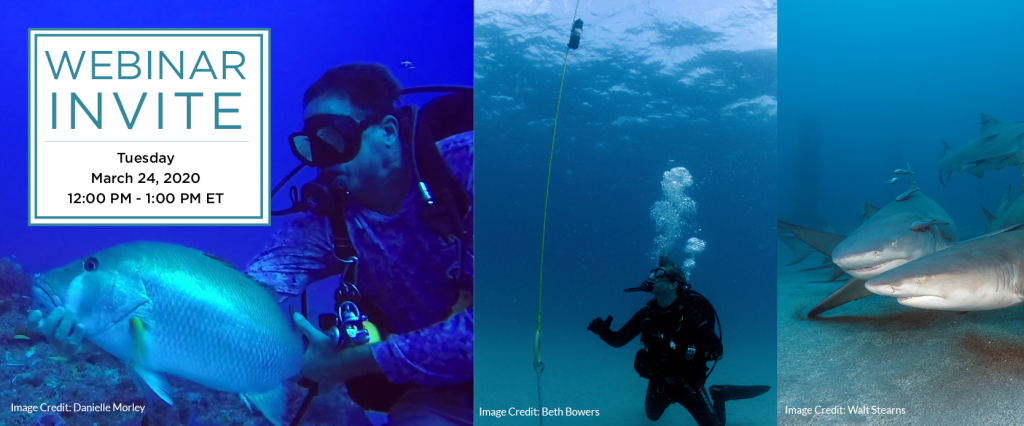
Join SECOORA for a webinar, March 24 at 12 PM ET, with Dr. Joy Young from The FACT Network. Dr. Joy Young will discuss how scientists in The FACT Network are working together to improve management of our aquatic resources through sharing data.
Date: March 24, 2020
Time: 12:00 – 1:00 PM ET
Speaker: Dr. Joy Young, The FACT Network
Click here to reserve your spot!
Abstract
Fish are constantly moving to seek prey, hide from predators, find good habitat, and mate. Some species have small movements, restricted to a bay or river, while other species exhibit large movements that cross state and international borders along the coast. Scientists are using electronic tagging technology to monitor the movements of fishes on small and large scales.
An electronic tag, inserted or attached to a fish or sea turtle, is detected by devices in the water called receivers. The compatibility of equipment, specifically the ability of the receiver to detect any tag regardless of who deployed it, has given rise to large networks of scientists sharing detection data.
The FACT Network is a community of like-minded scientists that have been sharing detection data since 2007. Currently, the FACT Network extends from New England down to southwest Florida and into the Bahamas and U.S. Caribbean. Novel discoveries have included an annual tripletail migration from Georgia into Florida and a seasonal shark nursery habitat along the beach near Cape Canaveral.
Ongoing research includes projects on spatial management of species and predicting migration shifts in response to our changing climate. By sharing data and working together, scientists can tackle bigger questions on bigger scales, helping to effectively manage our aquatic resources.
About the Presenter
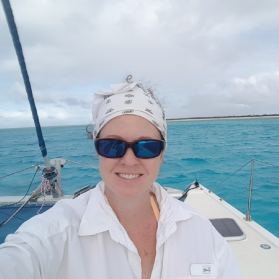
The FACT Network
Joy Young, PhD, brings a holistic approach to understanding the life history and ecology of fishes, specifically as it relates to management. She has an established background in age and growth, genetics, reproduction, movement and parasites of fishes.
As a biologist with more than 22 years of experience, she’s worked for MER Consultants, the Florida Fish and Wildlife Conservation Commission, Philadelphia Watershed Department, Bimini Biological Field Station, and even Sea World. She has organized national symposia on increasing underrepresented minorities in the field of fisheries and guest lectures at Florida high school and universities on the current and future state of fisheries in Florida.
Her passion is conducting collaborative research using complimentary areas of science to bridge the gap between scientists, managers, and the public. As data manager for the FACT Network for the past eleven years, she has helped build a network of over ninety organizations using acoustic telemetry in the United States, Bahamas, and Caribbean. Her newest project involves using acoustic telemetry to resolve questions on movement that have direction implication on management of stocks.
Related news
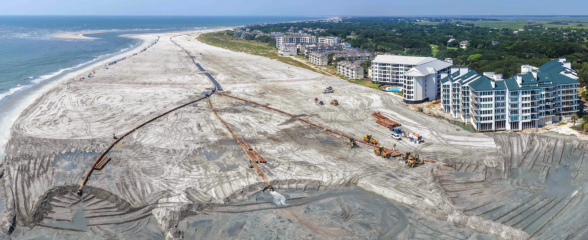
At the Water’s Edge: Lowcountry Coastlines in a Brave New World
A nor'easter's record storm tide. A stalled tropical storm. Two Lowcountry towns adapting to a new era of flooding, with SECOORA data in hand.

Above the High Tide: Water Level Sensors on the Front Line
SECOORA's Southeast Water Level Network has installed 100+ sensors across the Carolinas, Georgia, and Florida, giving communities real-time flood data.
SECOORA is Hiring a Grants Manager
SECOORA is hiring a Grants Manager to lead grant and subaward management across a four-state coastal ocean observing network. Based in the Southeast US. Apply now.