

Join SECOORA for a webinar that analyzes the West Florida Continental Shelf’s response to Hurricane Irma using a combination of in situ observations and numerical circulation models. More info below!
West Florida Shelf and Tampa Bay Responses to Hurricane Irma: What Happened and Why
Presenter: Dr. Bob Weisberg, University of South Florida College of Marine Science
Date: February 13, 12 PM ET
Hurricane Irma impacted the west Florida continental shelf (WFS) as it transited the State of Florida from September 10-12, 2017, first making landfall at Cudjoe Key and then again at Naples, as a Category 2 hurricane. The WFS response to Irma is analyzed using a combination of in situ observations and numerical circulation models. The observations include water column velocity, sea surface temperature, winds and sea level. The models are: 1) the West Florida Coastal Ocean Model (WFCOM) that downscales from the deep Gulf of Mexico, across the shelf and into the estuaries by nesting the unstructured grid FVCOM in the Gulf of Mexico HYCOM and 2) the Tampa Bay Coastal Ocean Model (TBCOM) that provides much higher resolution for the Tampa Bay vicinity (Tampa Bay, Sarasota Bay, the Intracoastal Waterway and all of the inlets connecting these with the Gulf of Mexico) by nesting FVCOM in WFCOM.
Both the observations and the model simulations revealed strong upwelling and vertical mixing followed by a downwelling as the storm passed by. This was accompanied by a rapid drop in sea surface temperature by about 4 degrees C and large decreases in sea level with negative surges causing drying in the Florida Bay, Charlotte Harbor, Tampa Bay estuaries and the Big Bend region. The transport and exchange of water between the shelf and the estuaries and between the shelf and the Florida Keys reef track during the hurricane have important ecosystem and sediment transport implications, including an inlet breach that occurred at the Pinellas Co. Shell Key preserve
About the Presenter
Dr. Robert Weisberg is a Distinguished University Professor of Physical Oceanography at the University of South Florida (USF). His current research emphasizes the West Florida Continental Shelf (WFS) and the interactions occurring between the shelf and the deep ocean and between the shelf and the estuaries. He maintains a coordinated program of in situ observations, analyses, and numerical circulation models aimed at describing and understanding the processes that determine WFS water properties, with applications to matters of societal concern. Dr. Weisberg is on the Board of Directors for the SECOORA and is a Fellow of the Southeastern Universities Research Association (SURA). Dr. Weisberg is a member of the Oceanography Society, the American Geophysical Union, the American Meteorological Society and Sigma Xi. He obtained his MS and PhD in physical oceanography in 1972 and 1975 from the University of Rhode Island.
Related news

Meet the new 2026 SECOORA Board Members
SECOORA welcomes three new members to its Board of Directors, effective July 1, 2026 - bringing fresh expertise in marine science, coastal geomorphology, and ecosystem restoration to guide our work across the Southeast.
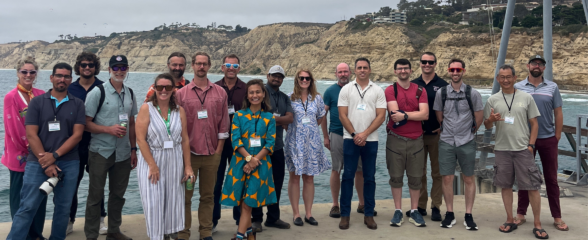
SECOORA Co-Hosts the 2026 WebCOOS Workshop In Person in La Jolla, CA
The 2026 WebCOOS Workshop convened in person on July 21-22, 2026 in La Jolla, CA. 45 attendees representing all 11 IOOS Regional Associations and national partners joined this collaborative workshop to discuss webcam-derived coastal products, stakeholder needs, and the network's transition into its next phase under IRA T2.

SET Webinar Series: Exploring Coastal Change: Digital Coast Resources
Join us on August 28, 2026, from 1:00 - 2:00 PM for the SECOORA SET Webinar Series, where we will explore coastal change using NOAA's Digital Coast resources. This webinar will bring together SET Community of Practice members and partners to learn how geospatial data and tools can support SET monitoring and place site-level observations within a broader landscape context.