

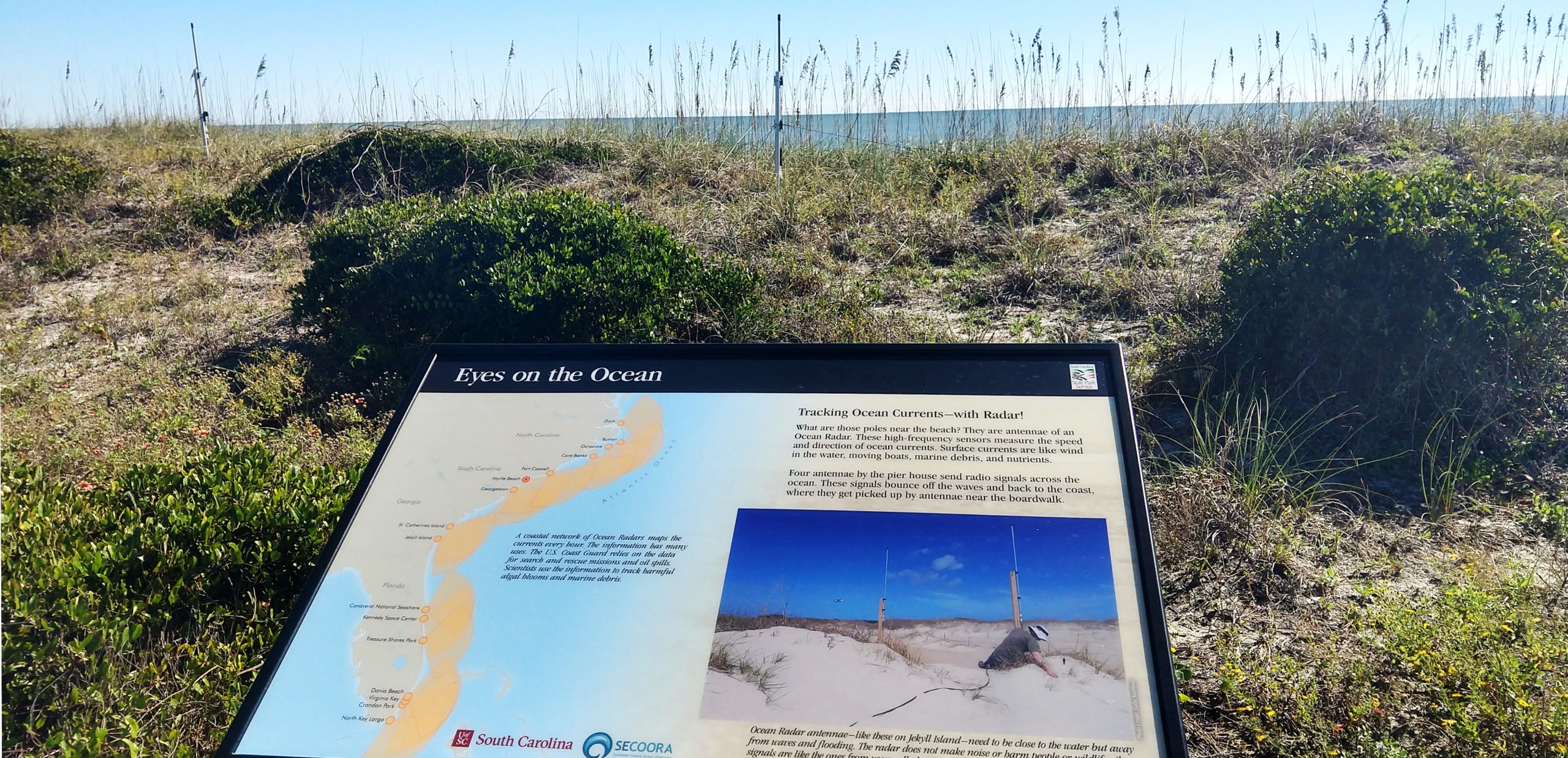
A new High Frequency Radar (HF radar) was installed in Myrtle Beach State Park by the University of South Carolina. The new HF radar system was installed to close a gap in HF Radar coverage between Caswell Beach, NC and Georgetown, SC.
Myrtle Beach State Park HF Radar

The radar antennas are located within Myrtle Beach State Park near the pier house. HF radar transmit radio signals across the ocean. These radio signals bounce off of ocean waves and signals are scattered back to the coast where they get picked up by the antennae. The returned signals are analyzed to estimate surface current speed and direction.
Why collect surface current data?
HF radar are land-based systems that measure the speed and direction of ocean surface currents in near real-time. Surface currents can move objects in the ocean such as boats, marine debris, and nutrients.
The data collected by HF radar has many uses, including U.S. Coast Guard search and rescue mission planning and oil-spill response efforts. Scientists use the surface current data to track harmful algal blooms and marine debris and to better understand ocean transport of larval fish, plankton, and nutrients.
Backbone of Coastal Ocean Observing Systems
HF radar networks form the backbone of many coastal ocean observing systems. The broad range of uses is the reason that the National Oceanic and Atmospheric Administration (NOAA) Integrated Ocean Observing System (IOOS®) invests in a national network of HF radar. SECOORA operates a growing network of HF radars in the Southeast. 17 HF Radar are currently deployed from North Carolina to the Gulf coast of Florida and 4 more HFR will be installed on the east coast of Florida by 2022.
The new HF radar was funded by IOOS as a national effort to close the gaps in monitoring the ocean.
Related news

Above the High Tide: Water Level Sensors on the Front Line
SECOORA's Southeast Water Level Network has installed 100+ sensors across the Carolinas, Georgia, and Florida, giving communities real-time flood data.
SECOORA is Hiring a Grants Manager
SECOORA is hiring a Grants Manager to lead grant and subaward management across a four-state coastal ocean observing network. Based in the Southeast US. Apply now.

Meet the new 2026 SECOORA Board Members
SECOORA welcomes three new members to its Board of Directors, effective July 1, 2026 - bringing fresh expertise in marine science, coastal geomorphology, and ecosystem restoration to guide our work across the Southeast.