

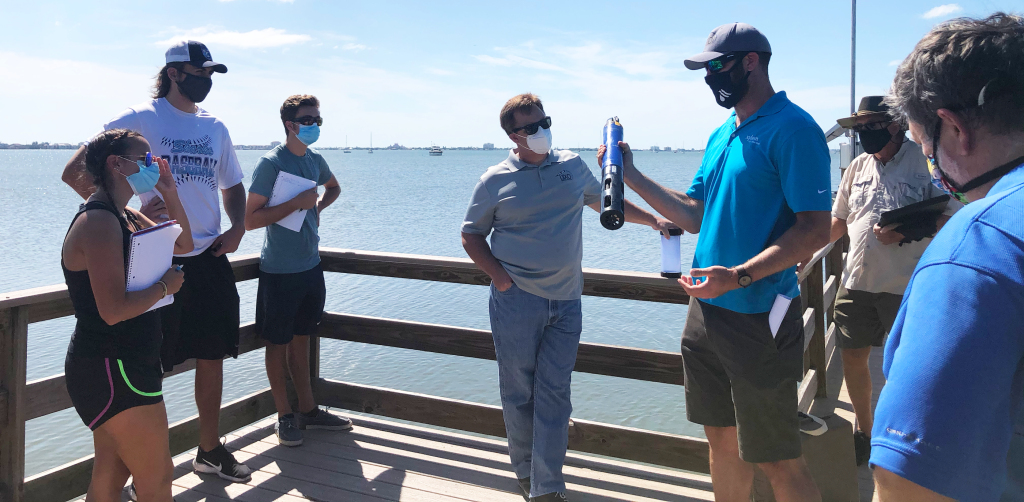
Pictured above is YSI Xylem representatives Brock Houston and Scott Wolf showing students the YSI Xylem EXO2 Multi-Parameter Water Quality Monitoring sonde.
On October 6th and 8th, undergraduate students from University of South Florida (USF) St. Petersburg environmental science lab made a field trip to the Clam Bayou water quality and meteorological station. The Clam Bayou station is operated through a partnership with YSI Xylem and the USF Coastal Ocean Monitoring Program.
During the tour, the students learned about the YSI Xylem EXO2 Multi-Parameter Water Quality Monitoring sonde from YSI Xylem representatives Brock Houston and Scott Wolf. The sonde measures salinity, dissolved oxygen, pH, water temperature, turbidity, chlorophyll, blue green algae, and fluorescent dissolved organic matter and depth. This water quality data augments the meteorological measurements from the same location which include air temperature, wind speed and gust, relative humidity, precipitation, and barometric pressure. Clam Bayou serves as a demonstration site highlighting the value of coastal environment data.
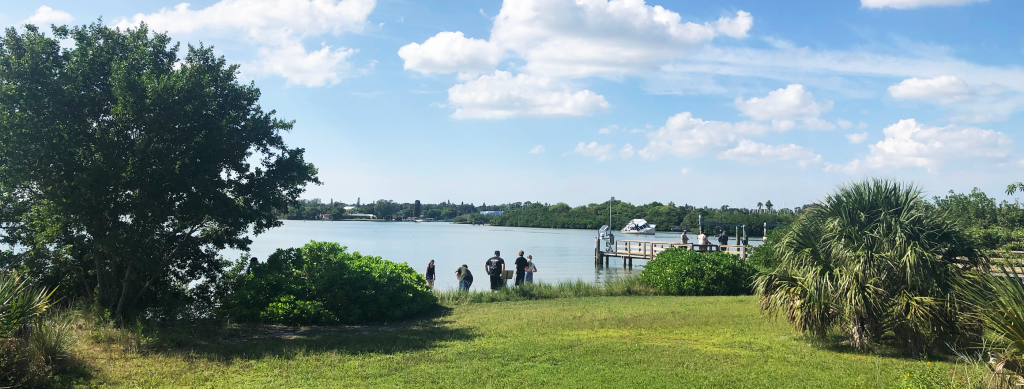
Students compared different methods for measuring water quality. The sonde provided an example of in situ autonomous water quality monitoring. The students then learned more traditional field sampling methods where they collected water and took the samples back to the lab for testing. Once testing is complete, they will compare their results to the sonde data.
Related news

Above the High Tide: Water Level Sensors on the Front Line
SECOORA's Southeast Water Level Network has installed 100+ sensors across the Carolinas, Georgia, and Florida, giving communities real-time flood data.
SECOORA is Hiring a Grants Manager
SECOORA is hiring a Grants Manager to lead grant and subaward management across a four-state coastal ocean observing network. Based in the Southeast US. Apply now.

Meet the new 2026 SECOORA Board Members
SECOORA welcomes three new members to its Board of Directors, effective July 1, 2026 - bringing fresh expertise in marine science, coastal geomorphology, and ecosystem restoration to guide our work across the Southeast.