

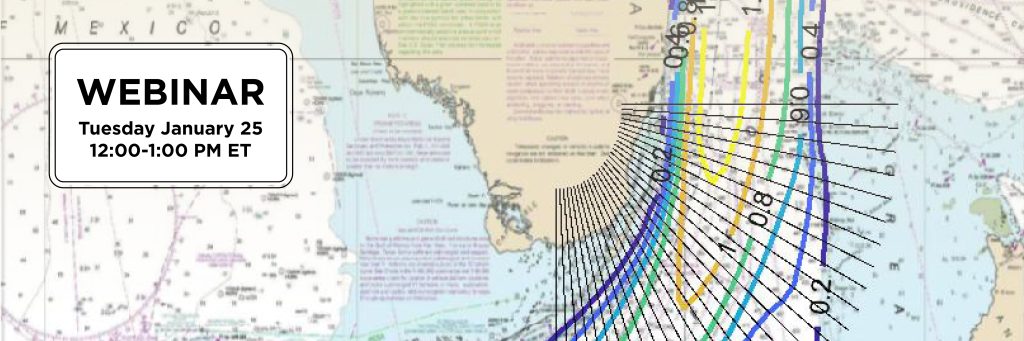
Join SECOORA for a webinar on January 25 at noon ET presented by Dr. Steven Meyers and Dr. Mark Luther, University of South Florida College of Marine Science. The technical webinar will overview the initial results of a prototype machine learning algorithm being developed to predict the probability of high cross-currents near Port of Miami.
Click here to reserve your spot for the webinar on January 25 at 12:00 PM ET.
Abstract
Major ocean currents can generate hazardous cross-currents near some ports. At the south Florida ports of Miami, Everglades, and Palm Beach, high cross-currents occur irregularly. Cross-currents can persist for hours to days as meanders in the Florida Current / Gulf Stream shift its position westward onto the port access channels. The technical webinar will overview the initial results of a prototype machine learning algorithm being developed to predict the probability of high cross-currents near Port of Miami.
Click here to reserve your spot for the webinar on January 25 at 12:00 PM ET.
Meet the Presenters
Dr. Steven Meyers
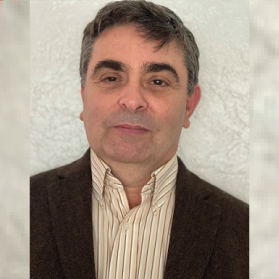
Dr. Steven D. Meyers is the Chief Scientist at the Center for Maritime and Port Studies at the University of South Florida College of Marine Science (USF CMS). He has over 20 years experience working with estuarine circulation models, climate variability, advanced data analysis, and more recently, artificial intelligence and machine learning. His work focuses on solving problems related to maritime operations, coastal infrastructure, and estuarine management. Before joining USF he was the Associate Director for Oceanography at the Center for Ocean-Atmosphere Prediction Studies at Florida State University. Dr. Meyers received his Ph.D. in physics from the University of Texas at Austin in 1990.
Dr. Mark Luther
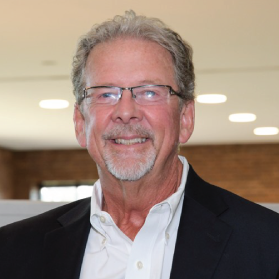
Mark E. Luther received his doctoral degree in Physical Oceanography from the University of North Carolina at Chapel Hill in 1982. Dr. Luther is an Associate Professor and director of the Center for Maritime and Port Studies in the University of South Florida College of Marine Science. He has worked in real-time ocean observing systems since 1993 and was involved in planning and implementation of the US Integrated Ocean Observing System from its inception (https://ioos.noaa.gov/). He works closely with the Tampa Port Authority, the Tampa Bay Pilots, US Coast Guard, and other maritime interests on environmental issues affecting and affected by maritime transportation operations and infrastructure. He is an avid boater with both power and sail boats and holds a US Coast Guard Captain’s License. He has been sailing the waters of Tampa Bay and west Florida since 1983.
Click here to reserve your spot for the webinar on January 25 at 12:00 PM ET.
Related news
SECOORA is Hiring a Grants Manager
SECOORA is hiring a Grants Manager to lead grant and subaward management across a four-state coastal ocean observing network. Based in the Southeast US. Apply now.

Meet the new 2026 SECOORA Board Members
SECOORA welcomes three new members to its Board of Directors, effective July 1, 2026 - bringing fresh expertise in marine science, coastal geomorphology, and ecosystem restoration to guide our work across the Southeast.
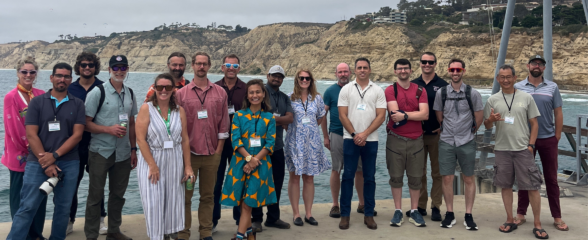
SECOORA Co-Hosts the 2026 WebCOOS Workshop In Person in La Jolla, CA
The 2026 WebCOOS Workshop convened in person on July 21-22, 2026 in La Jolla, CA. 45 attendees representing all 11 IOOS Regional Associations and national partners joined this collaborative workshop to discuss webcam-derived coastal products, stakeholder needs, and the network's transition into its next phase under IRA T2.