

Charleston Coastal Flood Monitoring: Camera Network and Data Insights
A new story map explores how cameras in Charleston, South Carolina are helping communities monitor and respond to changing coastal conditions, from everyday weather impacts to flooding events. As a rapidly growing coastal city with a major working port, Charleston depends on an accurate understanding of water conditions to support transportation, public safety, infrastructure, and economic activity.

A new story map highlights how cameras in Charleston, South Carolina are helping communities better understand and respond to coastal conditions from daily weather impacts to flooding events.
Water plays a central role in Charleston’s economy and daily life. Understanding coastal conditions is critical as the community is experiencing rapid population growth, supports a major working port, and experiences hazards like fog and flooding that impact transportation, safety, and infrastructure.
Imagery for Fog and Flood Monitoring
Cameras located on the Charleston peninsula provide views of conditions in and around the harbor.
One camera, positioned on the Charleston Branch Pilots pier, overlooks Charleston Harbor, the Cooper River, and surrounding infrastructure. Co-located with a NOAA tide gauge, it supports a partnership between NOAA, local stakeholders, and the camera team to monitor conditions in the harbor and flooding.
This imagery is helpful for forecasters. National Weather Service teams use camera feeds to track conditions like sea fog, which is one of the leading weather-related hazards affecting port operations. Time-lapse imagery from multiple camera angles helps improve forecast accuracy and warning capabilities.
“Creating short time-lapse loops from multiple webcam perspectives around Charleston Harbor has been invaluable for monitoring sea fog, which directly contributes to more accurate forecasts and warnings. Fog is the leading weather-related hazard affecting the Port of Charleston and shipping operations, so having these real-time observations in the harbor has been a game-changer for NWS forecasters.” – Jonathan Lamb, Charleston Weather Forecast Office Meteorologist with NOAA.
Supporting Communities on the Ground
Beyond forecasting, these cameras provide direct value to local communities.
In the Rosemont community, flooding is a known concern. A camera documents impacts to roads, homes, and green spaces. Paired with an air quality monitor, it helps provide a more complete picture of environmental conditions and potential risks to human health.
Developed In partnership with the Lowcountry Alliance for Model Communities (LAMC), the Charleston Citizen Research to Action Board (CCRAB), and the Rosemont Neighborhood Council, this effort ensures that data and imagery are not only collected but shared in ways that are meaningful and useful to the community.
Capturing Flooding During Storm Events
The benefit of these systems becomes especially clear during storm events.
During a December 2023 nor’easter, cameras captured flooding in Charleston. When paired with nearby NOAA tide station data, the imagery provides important context and shows how recorded water levels translate to real-world impacts on streets and infrastructure.
This combination of data and imagery helps improve understanding of flooding extent and supports better preparedness and response.
Why It Matters
By combining imagery with environmental data, these systems are supporting better decisions for forecasters, emergency managers, and communities, and help bridge the gap between measurements and lived experience.
About WebCOOS
This effort is part of the Webcam Coastal Observation System (WebCOOS). WebCOOS is a growing network of coastal cameras that provides real-time views of shoreline conditions. Using low-cost technology and image-based analysis, WebCOOS supports coastal monitoring, improves safety, and helps communities better understand and respond to changing conditions.
Interested in bringing WebCOOS to your community? Reach out to webcoos@secoora.org.
Related news
SECOORA is Hiring a Grants Manager
SECOORA is hiring a Grants Manager to lead grant and subaward management across a four-state coastal ocean observing network. Based in the Southeast US. Apply now.

Meet the new 2026 SECOORA Board Members
SECOORA welcomes three new members to its Board of Directors, effective July 1, 2026 - bringing fresh expertise in marine science, coastal geomorphology, and ecosystem restoration to guide our work across the Southeast.
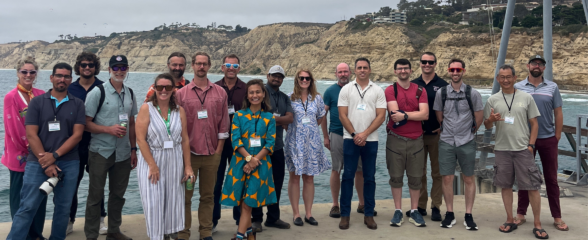
SECOORA Co-Hosts the 2026 WebCOOS Workshop In Person in La Jolla, CA
The 2026 WebCOOS Workshop convened in person on July 21-22, 2026 in La Jolla, CA. 45 attendees representing all 11 IOOS Regional Associations and national partners joined this collaborative workshop to discuss webcam-derived coastal products, stakeholder needs, and the network's transition into its next phase under IRA T2.