

Species Spotlight: Trichodesmium
Discover the remarkable role of Trichodesmium, a microscopic cyanobacterium that helps fuel life across the ocean. In this Species Spotlight, explore how researchers supported by the Marine Biodiversity Observation Network (MBON) are using imaging technology, genomics, and eDNA to better understand this “shape-shifting” organism and its influence on marine ecosystems, ocean health, and coastal economies.

By Zoraida Díaz
A Microscopic Powerhouse
Trichodesmium, a colony-forming cyanobacterium, is one of the most prolific and visible phytoplankton in the open sea and plays a critical role in the health of the world’s oceans. Trichodesmium is a diazotroph, meaning it takes nitrogen gas (N₂) from the air and converts it into ammonium (NH₄+), a nitrogen fertilizer essential to other marine plants and animals.
Scientific estimates suggest that Tricholdesmium contributes to 25% to 50% of nitrogen fixation in the world’s tropical and subtropical oceans, depending on seasonal blooms and climate conditions.
By performing this critical task, Trichodesmium fuels entire ecosystems. When the colonies bloom, they release significant amounts of their fixed nitrogen into the surrounding water. This allows other phytoplankton species to flourish, initiating a chain reaction that supports all species–from tiny copepods to large marine predators.
But large-scale blooms can also become “too much of a good thing.” They form in coastal or oceanic waters, often when the water becomes still, and surface temperatures exceed 27 ℃ (80.6 °F). When the bloom reaches the end of its life cycle, the algae die and sink to the bottom. The decomposition of large-scale blooms consumes vast amounts of dissolved oxygen, creating hypoxic conditions in which oxygen is depleted, killing fish and other marine life.
Blooms have also been credited with releasing a potent marine toxin, which causes Clupeotoxism, a rare and often fatal type of food poisoning in humans after ingesting fish tainted with the toxin. Understanding the movement of toxins from microscopic producers like Trichodesmium into the food web is a key part of forecasting risks to human health and coastal economies.
On a more positive note, recent studies have shown that the waste biomass of Trichodesmium erythraeum has untapped potential in medicinal and ecological applications. Lab tests showed that the bioactive compounds released during decomposition, when tested in a methanolic solvent, killed various mosquito species, including the Dengue-transmitting Aedes aegypti, and exhibited antibacterial and anticancer properties.
Puffs and Tufts; Specialized Divisions
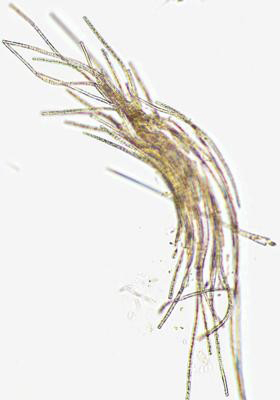
A unique characteristic of Trichodesmium is its ability to form macroscopic colonies that can be observed underwater with imaging devices such as the Continuous Plankton Imaging and Classification System (CPICS) or from collected water samples using the cost-effective PlanktoScope digital microscope. Marine scientists on collaborative global and US-based research expeditions on ships, including NOAA’s South Florida Ecosystem Restoration effort, detect three distinct morphotypes of Trichodesmium with the CPICS: single filaments, “puffs”, and “tufts.” The puffs look like a cluster of hair-like filaments radiating from a core, whereas the tufts are like bundles of wheat with their filaments stacked parallel to each other. These physical structures act as floating reefs for tiny organisms such as bacteria, larvae, and crustaceans.
For decades, the visual differences led scientists to assume that puffs and tufts were distinct species with distinct roles. However, recent genomics data have debunked this long-held assumption. Research stemming from collaborative global ocean sampling programs, such as the Tara Oceans project, found that both puffs and tufts belong to the same species. This suggests that the “shape-shifter” Trichodesmium can change its physical form in response to environmental cues. Hypotheses abound on the reasons for the cyanobacteria’s shape-shifting abilities: Does a puff shape help the colony trap iron-rich dust more effectively? Does a tuft shape provide a hydrodynamic advantage in choppy water?
A Multi-Tool Approach
The Marine Biodiversity Observation Network (MBON) supports a multidisciplinary approach to the study of Trichodesmium and its vital role in the health of marine ecosystems and of our planet.
In addition to tracking blooms via satellite to forecast ecological shifts, researchers are using environmental DNA (eDNA) to match observed morphotypes (form) with specific genotypes (genetic make-up). “This is one way to determine whether puffs and tufts belong to the same species,” says Dr. Enrique Montes, Associate Scientist at the Cooperative Institute for Marine and Atmospheric Studies (CIMAS) and lab director of NOAA’s Ecosystem Assessment and Modeling group.Discovering how Trichodesmium optimizes its shape and abundance to survive may be the key to predicting how nitrogen fixation, and by extension the functioning of marine ecosystems, will shift as our oceans continue to change.
This work was supported by the U.S. Marine Biodiversity Observation Network (MBON) co-organized by NOAA, NASA, BOEM, and ONR through the National Oceanographic Partnership Program (NOPP).
Related news

SECOORA is Hiring a Grants Manager
SECOORA is hiring a Grants Manager to lead grant and subaward management across a four-state coastal ocean observing network. Based in the Southeast US. Apply now.

Meet the new 2026 SECOORA Board Members
SECOORA welcomes three new members to its Board of Directors, effective July 1, 2026 - bringing fresh expertise in marine science, coastal geomorphology, and ecosystem restoration to guide our work across the Southeast.
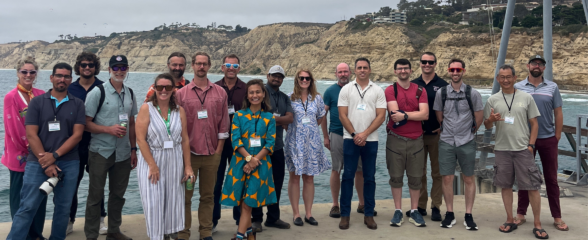
SECOORA Co-Hosts the 2026 WebCOOS Workshop In Person in La Jolla, CA
The 2026 WebCOOS Workshop convened in person on July 21-22, 2026 in La Jolla, CA. 45 attendees representing all 11 IOOS Regional Associations and national partners joined this collaborative workshop to discuss webcam-derived coastal products, stakeholder needs, and the network's transition into its next phase under IRA T2.