

Welcoming Our Newest Board Members
SECOORA is pleased to welcome three new faces to its Board of Directors, effective July 1, 2026. Together, they bring decades of experience spanning marine science, coastal geomorphology, ecosystem restoration, and applied research, expertise that will help guide SECOORA’s work across the Southeast in the years ahead.
Joining the Board in Academic/Research/Education seats are Tom Frazer of the University of South Florida, Dean of the College of Marine Science and Executive Director of the Florida Flood Hub for Applied Research and Innovation, and Adam Greer of the University of Georgia, whose research focuses on the oceanographic and behavioral processes shaping zooplankton communities. Christy Swann of RCOAST steps into the Industry/Private Sector seat, bringing two decades of award-winning research on windblown sand, from Earth’s beaches to the surface of Mars, and a mission to put research-grade tools in the hands of everyday coastal communities. Please join us in welcoming them to the SECOORA family.
Read their biographies below.
Dr. Tom Frazer
Academic/Research/Education

Thomas K. Frazer, Ph.D., is a nationally recognized marine scientist, academic leader, and environmental policy expert. His career spans more than three decades of research, higher education leadership, and public service. He currently serves as Dean of the College of Marine Science at the University of South Florida (USF) and Executive Director of the Florida Flood Hub for Applied Research and Innovation.
Dr. Frazer earned a B.S. in Marine Fisheries from Humboldt State University, an M.S. in Fisheries and Aquatic Sciences from the University of Florida, and a Ph.D. in Biological Sciences from the University of California, Santa Barbara. Prior to joining USF in 2020, he held several leadership positions at the University of Florida, including Director of the School of Natural Resources and Environment and Acting Director of the UF Water Institute. He also served as Florida’s Chief Science Officer from 2019 to 2021, advising state leaders on environmental research, science policy, and emerging environmental challenges.
An interdisciplinary scientist, Dr. Frazer’s research focuses on the impacts of human activities on freshwater and marine ecosystems and the application of science to environmental policy and management. His work has addressed climate resilience, flooding and sea-level rise, fisheries sustainability, coastal water quality, seagrass and coral reef ecology, invasive species, and ecosystem restoration. He has authored more than 200 scientific publications, book chapters, technical reports, and extension publications and led numerous multimillion-dollar research initiatives supported by a broad suite of federal and state agencies.
Committed to education and public service, Dr. Frazer has mentored generations of scientists, served on more than 140 graduate committees, and held leadership roles on numerous state and national advisory boards. His contributions have been recognized through election to the Academy of Science, Engineering and Medicine of Florida, designation as a Research Foundation Professor at the University of Florida, and membership in Sigma Xi.
Dr. Adam Greer
Academic/Research/Education

Dr. Adam Greer is an Assistant Professor with the University of Georgia, Skidaway Institute of Oceanography. His research focuses on the oceanographic, life history, and behavioral processes controlling the abundance and spatial distribution of zooplankton populations. Dr. Greer has a B.A. in Ecology, Evolution and Organismal Biology from Vanderbilt University and a Ph.D. in Marine Biology and Fisheries from the University of Miami.
Dr. Greer’s research team uses towed camera systems, oceanographic sensors, and more conventional gear (e.g., plankton nets) to study zooplankton communities. These towed camera systems and associated sensors provide a “new view” of ocean life by resolving detailed spatial relationships among zooplankton taxa, as well as provide novel insights into zooplankton interactions and behavior. Dr. Greer is also applying artificial intelligence and other computational techniques to analyze imagery/video datasets to capabilities for unraveling complex ecological relationships. Adam Greer’s research focuses on the oceanographic, life history, and behavioral processes that control the abundance and spatial distribution of zooplankton populations, a critical link between the ocean’s primary production and economically important fish species.
Using in situ imaging and other high-resolution sampling technologies, Adam studies the physical and biological conditions that shape zooplankton community structure. The detailed datasets these imaging systems produce reveal how zooplankton interact, opening new avenues for understanding ocean ecology and informing the design of experiments and models that identify the key drivers of zooplankton abundance.
Dr. Christy Swann
Industry/Private Sector
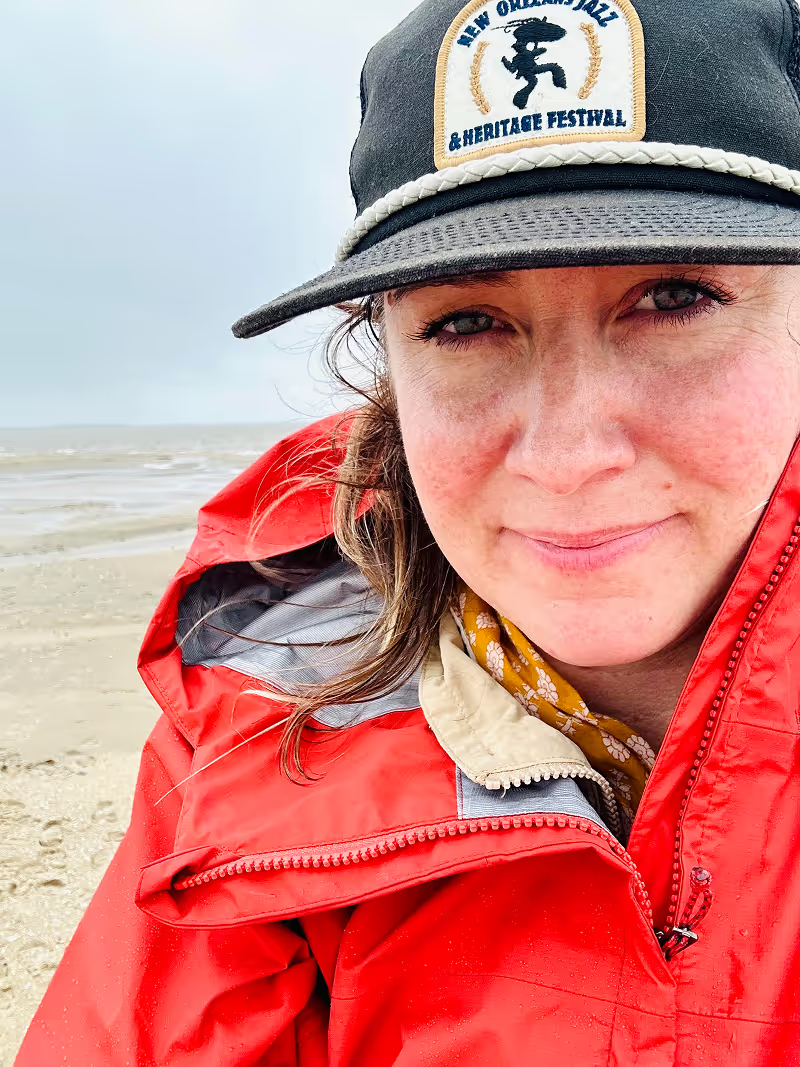
Dr. Christy Swann is an internationally-recognized, award-winning Earth and Planetary scientist with 20 years of experience studying windblown sand on beaches from Brazil to the Netherlands and even the windy, dusty environment of Mars. Throughout her scientific career, she has built innovative technology that pushes the forefront of our technological capabilities and scientific understanding of Aeolian Geomorphology.
Dr. Swann earned her Bachelor’s and Master’s degrees from East Carolina University where her research led her to develop the Wind Potential Index which created a method for scientists and planners to estimate the volume of windblown sand accreted during individual wind events. Dr. Swann then went on to Texas A&M University where she earned her Ph.D.
During her Ph.D., Dr. Swann started building her own instruments to solve unanswered scientific problems and designed the first instrument capable of discerning the minimum wind speed needed to mobilize windblown sand to enable the dune building process. Her internationally-recognized publications on her scientific breakthroughs were recognized by the NASA Curiosity team, who was looking through the lens of Curiosity on Mars and unable to understand why the current windblown sand models were not working. Dr. Swann’s recent breakthrough from her PhD work led to a NASA postdoctoral fellowship, where she adapted her earth instrumentation for Mars and ran a multitude of experiments at NASA Ames in a Mars low-pressure wind tunnel to solve the Curiosity conundrum. From that work, Dr. Swann unraveled a long-standing question on the fundamental physics of windblown sand and developed a model that predicts the minimum wind speed needed to mobilize sand on Mars, which is how the Red Planet’s dust storms begin. This research won her two prestigious national awards for research excellence: the G.K. Gilbert award and the Alan Berman award.
In March of 2023, Dr. Swann left the Naval Research Laboratory to start her own company, RCOAST, which places the tools used in the highest levels of research science in the hands of everyday consumers. Her goal in starting RCOAST was to empower people to make educated decisions that will help to make our coast more resilient. Additionally, she makes time to mentor young students to promote STEM, women-in-science, and entrepreneurship to empower the next generation of groundbreaking scientists, engineers and business owners. She is currently on the board for the international organization of Women in Coastal Geoscience and Engineering where she is a mentor for young women scientists.
Related news

Above the High Tide: Water Level Sensors on the Front Line
SECOORA's Southeast Water Level Network has installed 100+ sensors across the Carolinas, Georgia, and Florida, giving communities real-time flood data.
SECOORA is Hiring a Grants Manager
SECOORA is hiring a Grants Manager to lead grant and subaward management across a four-state coastal ocean observing network. Based in the Southeast US. Apply now.

Meet the new 2026 SECOORA Board Members
SECOORA welcomes three new members to its Board of Directors, effective July 1, 2026 - bringing fresh expertise in marine science, coastal geomorphology, and ecosystem restoration to guide our work across the Southeast.