

Reimagining the Deep: BioTrack and the Whitespotted Eagle Rays of Florida’s Indian River Lagoon

By Zoraida Díaz
Since joining Florida Atlantic University’s (FAU) Harbor Branch Oceanographic Institute in 2016, Associate Research Professor Matt Ajemian has tagged hundreds of marine animals in Florida’s Indian River Lagoon, documenting species such as bull sharks, sea turtles, smalltooth sawfish, and whitespotted eagle rays. As head of the Fisheries Ecology and Conservation Lab (FEC) at FAU Harbor Branch, Dr. Ajemian contributes the lab’s tracking data to the regional SECOORA-supported Florida Atlantic Coast Telemetry (FACT) Network, an acoustic data partner and regional gateway for the national Animal Telemetry Network (ATN).
Most recently, the FEC Lab is also sharing its data on tagged whitespotted eagle rays with BioTrack, an ambitious initiative that uses acoustic and satellite tracking data to map and predict marine biodiversity hotspots—geographic areas with high concentrations of diverse species. Supported by the US Marine Biodiversity Observation Network (MBON) and the Animal Telemetry Network (ATN), BioTrack leverages established academic and government networks along the Atlantic Coast—from Maine to the Florida Keys and into the Gulf—to integrate and share critical tracking data.
The BioTrack project already includes historical and newly generated data from more than 3,000 tagged animals, representing over 60 species. BioTrack’s mission to aggregate and analyze individual tracking data across expansive geographic areas will provide a broader picture of key biodiversity hotspots that drive the food web and sustain our oceans.
Endangered Estuary Haven
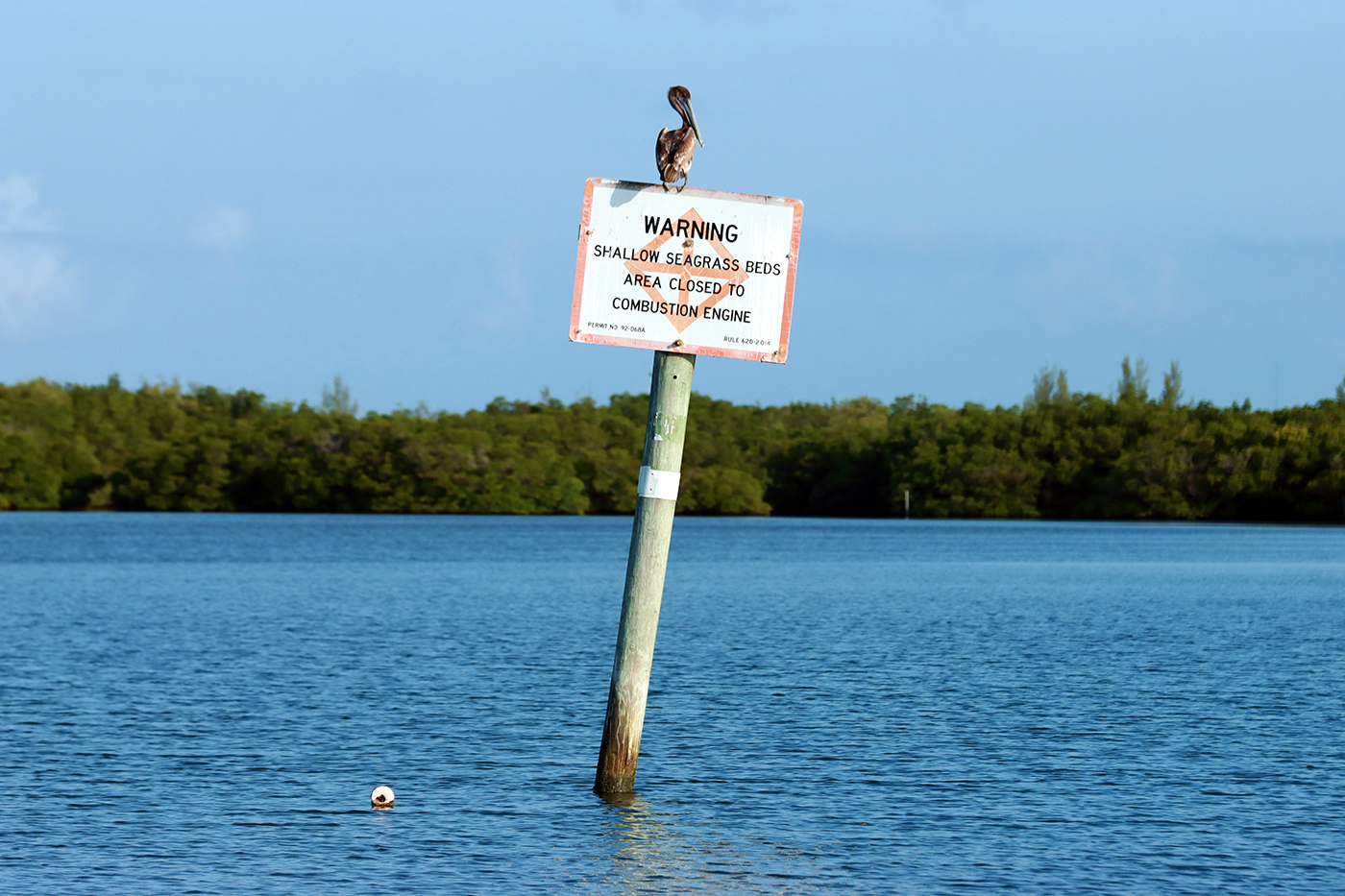
The Indian River Lagoon is one of the most complex and biologically diverse estuaries in the Northern Hemisphere. It spans a transition zone between the temperate climate of the American Southeast and the subtropical climate of the Caribbean, and serves as a vital sanctuary for threatened or endangered species.
Aside from the Intracoastal Waterway, a dredged navigation channel, the lagoon averages just 3 feet (less than 1 meter) deep. The 156-mile (251 km) ribbon of water stretches from Ponce de Leon Inlet in Volusia County down to Jupiter Inlet in Palm Beach County.
Sunlight penetrates the shallow lagoon, supporting meadows of seagrass, the primary nursery, oxygen factory, and food source for more than 4,000 plant and animal species cataloged within the watershed.
Manatees and sea turtles, alongside key lagoon predators—including bull sharks, bottlenose dolphins, and whitespotted eagle rays—rely on the tangled mangrove nurseries for their vulnerable newborns and on the rich seagrass pastures for the developing adults.
Long-term monitoring by the St. Johns River Water Management District showed that in the last decade, the estuary lost 58% of its total seagrass coverage, alongside a severe thinning of the remaining beds. Crippling algal blooms driven by stormwater runoff and septic waste caused the habitat’s collapse, devastating the estuary’s biodiversity. Mapping the movements of benthopelagic species, such as the whitespotted eagle rays, which forage on the seabed but swim in the water column, serves as a gauge of the Indian River Lagoon’s overall health.
Spotting the Whitespotted Eagle Ray

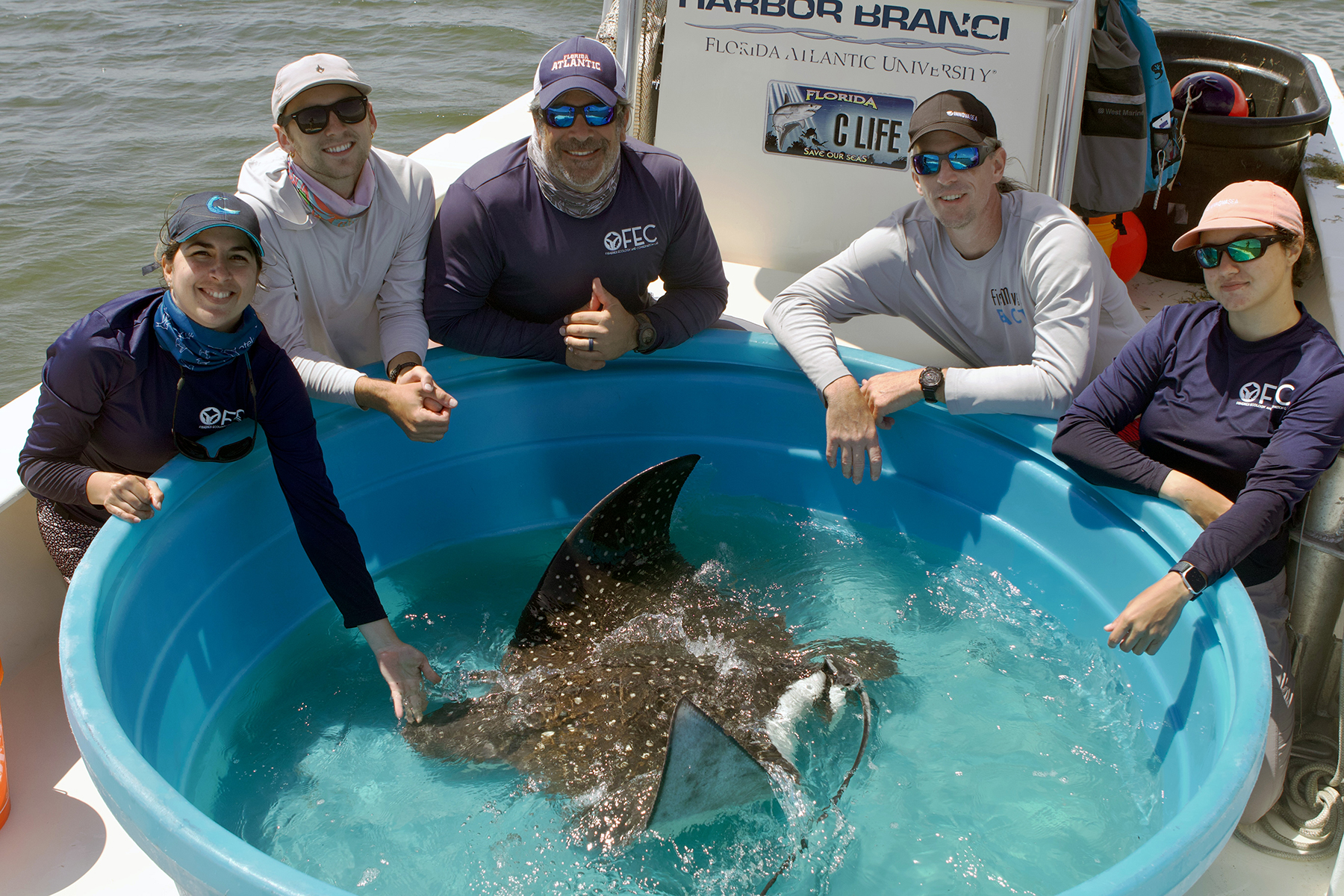
The FAU Oceanographic Institute’s research vessel exits the Harbor Branch Canal into the Indian River Lagoon near Fort Pierce. Led by Dr. Matt Ajemian, the research team includes Dr. Ariadna Rojas Corzo, Lab Manager and PhD candidate Mike McAllister, PhD student Cecilia M. Hampton, and master’s student Adam Steinfeld. They are on a mission to tag the whitespotted eagle ray (Aetobatus narinari), listed as endangered by the International Union for Conservation of Nature (IUCN).
The boat throttles gingerly over the shallow waters until it reaches the Intracoastal Waterway. Gathering speed, it passes under the Fort Pierce South Causeway Bridge and heads towards mangrove-forested isles, where the FAU researchers scan the water for eagle rays. Pelicans perch on navigation markers, and a manatee’s nostrils poke out of the water.
The boat slows down near a marker buoy pinpointing the position of one of the 19 acoustic receiver stations managed by the FEC Lab, which function as “underwater listening stations.” Each receiver stores data, including the tag ID, date, and time, for tagged animals that swim within approximately 330 to 650 feet (100 to 200 meters). The stations are deployed to cover migratory passages and habitat hotspots, forming a strategic grid concentrated around the Fort Pierce Inlet and surrounding Indian River Lagoon waters.
“We’ll be putting out BioTrack transmitters that can be detected by those stations as well as those of many other folks distributed along the Atlantic coast,” explains Dr. Ajemian, “and that helps us when the animals leave our area—we can still track their migrations through this collaborative effort.”
With no rays in sight, the boat turns back toward the channel in the Fort Pierce Inlet, where McAllister finally spots two rays from the flybridge. The researchers begin a practiced team effort to capture the animals. Dr. Rojas Corzo and doctoral researcher Hampton throw a specialized seine net overboard while McAllister steers the boat to encircle the rays.
The boat pulls the net into a giant circle. The top of the net has a float line that keeps it pinned to the surface, while the bottom has a lead line that sinks to the bottom, creating a vertical barrier.
“I think we lost one,” says McAllister as he watches a ray slip past the net and swim away.
“Pull the line!”
The researchers pull the lines in long, coordinated strokes, pausing only to untangle the mesh. They reel the net back into a bin on deck, narrowing the circle until the caught ray is safely secured alongside the boat. Dr. Ajemian carefully removes the venomous defensive spines at the base of the ray’s tail, which will grow back in a few months. He then places a specialized in-water circular sling beneath the animal. The sling is hoisted with a pulley towards the bow, where the ray is lowered into what looks like a child’s bright blue plastic pool filled with buckets of freshly gathered ambient water.

A Spotted Eagle Ray’s Life
The ray has white polka-dot-like markings scattered over a velvety, dark-brown body—each pattern as unique as a fingerprint. With its large pectoral fins stretched open, the ray measures 5.7 feet (174 cm) from wingtip to wingtip. It barely fits in the pool.
Hampton uses a scanner to check if the ray has been previously tagged—it has not. While Dr. Ajemian clips a skin biopsy from the back tip of the pectoral fin, Dr. Rojas Corzo readies to perform an ultrasound on the female ray. Adjusting the monitor, she drapes a cloth over her head to minimize the sun’s glare. The ray is feisty, and Dr. Rojas Corzo is drenched. She waits for the animal to calm, then slides the probe over its lower dorsal side to locate the two uteri.
“She is pregnant,” says Dr. Rojas Corzo’s muffled voice, as cheers erupt on the boat.
“With twins!”
Dr. Rojas Corzo, who recently completed her dissertation on the conservation ecology of the whitespotted eagle ray, is focusing her postdoctoral research on the ray’s nursery habitats.
“Because this species is highly mobile and can range across vast areas, focusing on nurseries, where the most vulnerable life stages—gravid females, newborns, and young-of-the-year—concentrate, is one of the most effective ways to support conservation and management,” Dr. Rojas Corzo explains.
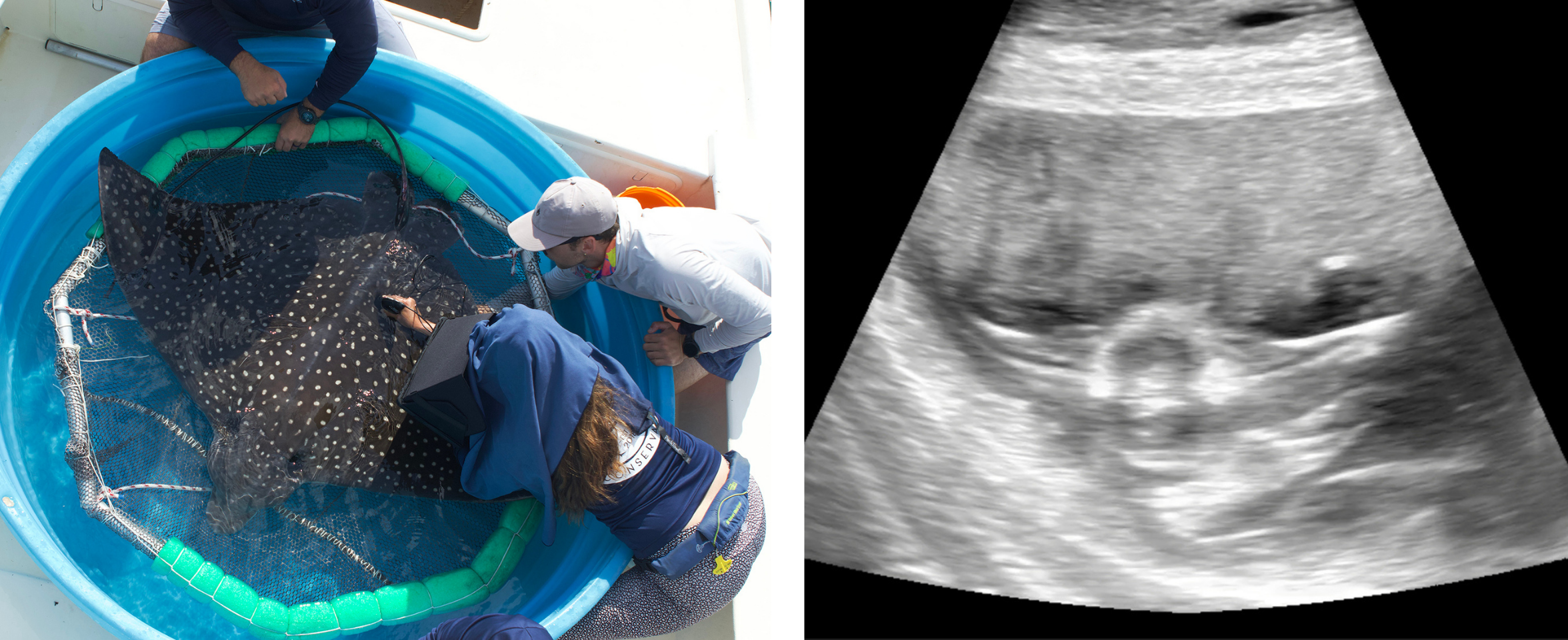
Dr. Ajemian clips an external acoustic transmitter mounted on a rototag the size of a silver dollar to the ray’s dorsal fin: “Because this ray is pregnant, we don’t want to risk doing a surgery to implant the BioTrack transmitter.”
“The rototag alerts the inlet receivers, while the biologger records body motions, as well as allowing us to hear the sound environment and what the animal is potentially crunching on. The video camera will record its environment, behaviors, and other animals—predators and prey,” he adds.
In 2022, Dr. Ajemian was awarded the prestigious National Science Foundation CAREER grant for a major 5-year research project focused on identifying when and where durophagous (shell-crushing) predators, such as whitespotted eagle rays, feed. His team’s pioneering methods use data from multi-sensor biologging packages attached to animals, capturing the specific “crunch” sounds rays make while feeding on bivalves like clams.
“Beyond simple detection, our approach provides insight into predator behavior itself,” said Dr. Ajemian.
These findings can guide shellfish restoration programs and shape strategies to deter rays from entering hard clam aquaculture nurseries in the Indian River Lagoon, thereby protecting commercial yields while safeguarding vulnerable ray populations.
Pioneering Eagle Ray Tracking
The Customized Animal Tracking Solutions (CATS Cam) module was modified for the biology of the ray by Dr. Ajemian’s team—including PhD student Cecilia Hampton—in partnership with Mote Marine Laboratory and Woods Hole Oceanographic Institution.
The neon-pink module, with suction cups and a satellite antenna, looks like an old walkie-talkie. Bungee-like cords with 3D-printed resin hooks on a Galvanic timed Release (GTR) metal pin attach over the dorsal ridge of cartilage above the ray’s spiracles (specialized breathing openings behind its eyes). The spiracles are an evolutionary adaptation that allows the ray to rest flat on the seafloor; instead of opening its mouth to inhale sand and debris, it draws clean water from above and pumps it out through the gill slits on its belly.
In a few smooth motions, Hampton, who is conducting her dissertation research on the foraging ecology of whitespotted eagle rays, measures the width between the spiracles, adjusts the length of the cords, and attaches the CATS Cam module to the flat dorsal surface of the pregnant ray’s head.

“This biologging package has a small onboard computer that records accelerometry [measures body motion & energy], spectroscopy [light & environment], and magnetometry [direction & navigation],” Hampton explains as she fits the anchoring hooks on the ray. “This allows us to collect a vast amount of data regarding how the tag is oriented in space, as well as the animal’s depth and water temperature, sampled many times per second.”
The biologger includes a hydrophone—essentially an underwater microphone—a camera lens, and an acoustic transmitter that communicates with underwater receivers, like the one we had located in the inlet earlier. The module’s GTR metal pin is designed to corrode and disintegrate after a specified period of time when exposed to water.
“When the package detaches after about three days, it floats with the antenna up, transmitting its location to a satellite so we can recover the data,” says Hampton.
At first glance, the CATS Cam module appears to be a heavy burden for the ray to carry. The camera sensor alone weighs 270 grams in air (9.5oz). With satellite tags and acoustic transmitters inside a foam housing, the total weight rises to 430 grams (15.2oz). But because the foam housing is buoyant and displaces seawater, the upward force offsets the module’s mass. This makes the CATS Cam virtually weightless in the water, while its low-profile shape minimizes any drag that could threaten the ray’s survival.
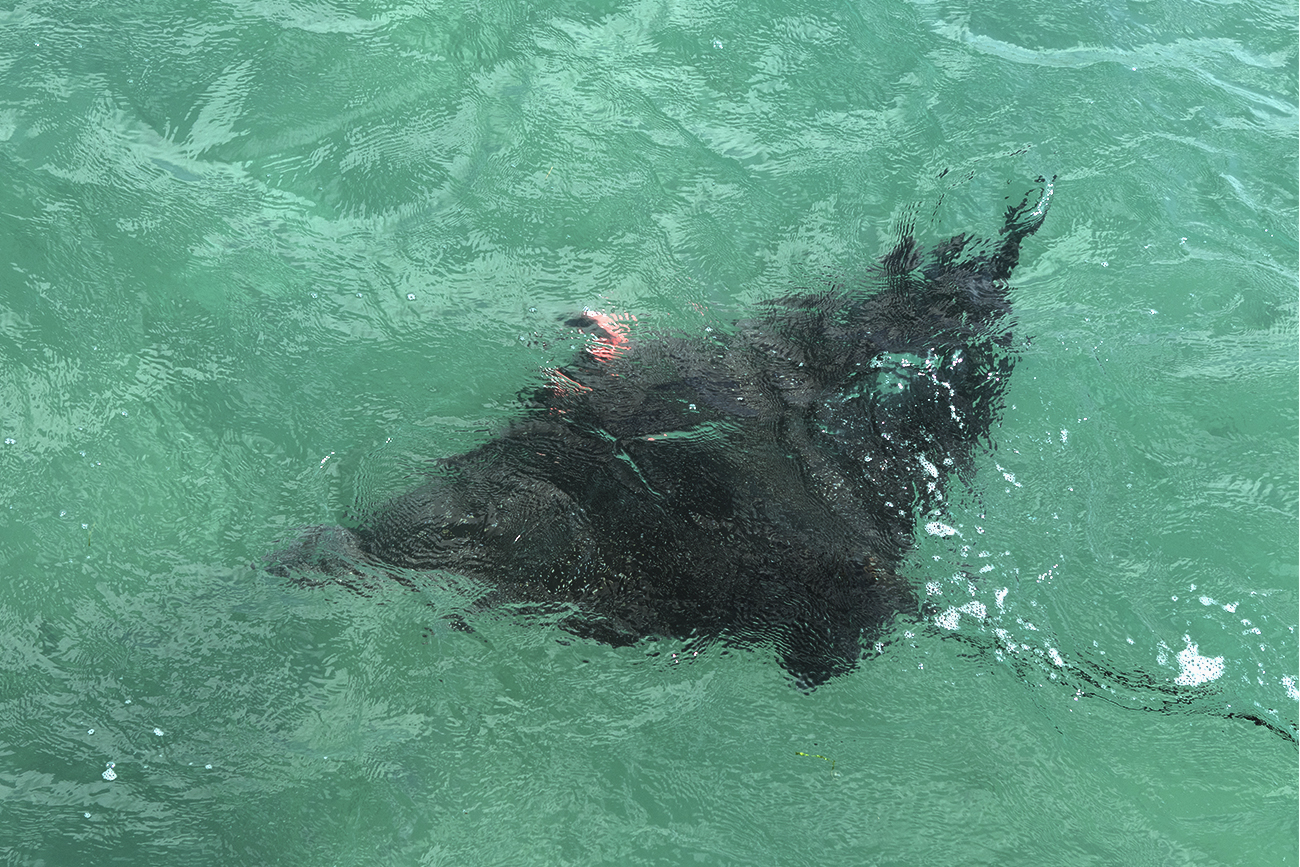
The sling is slid under the ray, hoisted to the side of the boat, and then gently lowered into the water. The pregnant ray takes off, flapping its wings, the neon pink visible through the water for a few more seconds. The entire process from capture to release took about 15 minutes.
Mapping an Eagle Ray’s Flight

The same capture and handling procedure was used on a second, slightly smaller ray with a 5.05 ft (154 cm) disk width, except this time the ray was gently turned over, exposing the milk-white underbelly. When rays and sharks are turned upside down, their sensory systems are disoriented, and they enter a natural trance-like state called tonic immobility. While Professor Ajemian cradled the ray in his arms, Dr. Rojas Corzo cleaned the site and made an inch-long incision. The small, cylindrical BioTrack transmitter was inserted into the abdominal cavity, and the wound was sutured with dissolving surgical thread. The acoustic tag on this ray is one of more than 200 BioTrack tags being deployed this year to expand the reach of the growing BioTrack universe.
“The CATS Cam provides a window into a day in the life of a ray, offering highly detailed information for 1-3 days,” says Dr. Rojas Corzo, “whereas this internal acoustic tag will provide long-term data on the animal’s movements for up to 4 years.”
“Pelagic rays like eagle rays were underrepresented in the current BioTrack dataset,” explains Dr. Ajemian. “Yet, these animals are important for mapping biodiversity hotspots; those insights will allow us to prioritize specific marine areas for protection, if needed.”
Dr. Ajemian is optimistic about the long-term benefits of the BioTrack project: “We look forward to using the BioTrack and MBON data to examine whether some of the species we’re tagging exhibit movements associated with broader-scale environmental changes in our area, including the presence and absence of other species.”
“This type of work cannot be done without meaningful and extensive collaborations like this one.”
This work was supported by the U.S. Marine Biodiversity Observation Network (MBON) co-organized by NOAA, NASA, BOEM, and ONR through the National Oceanographic Partnership Program (NOPP).
Related news

Dave Wells Joins SECOORA as Ocean Observing Systems Team Lead
SECOORA welcomes Dave Wells as Ocean Observing Systems Team Lead where he will oversee SECOORA's coastal observing system assets and data management.
At the Water’s Edge: Lowcountry Coastlines in a Brave New World
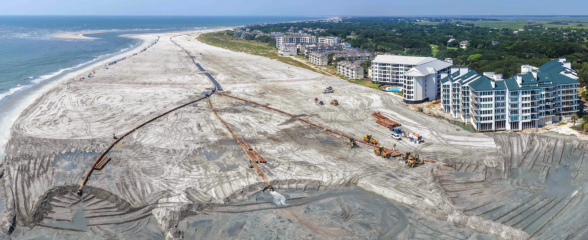
A nor'easter's record storm tide. A stalled tropical storm. Two Lowcountry towns adapting to a new era of flooding, with SECOORA data in hand.

Above the High Tide: Water Level Sensors on the Front Line
SECOORA's Southeast Water Level Network has installed 100+ sensors across the Carolinas, Georgia, and Florida, giving communities real-time flood data.