

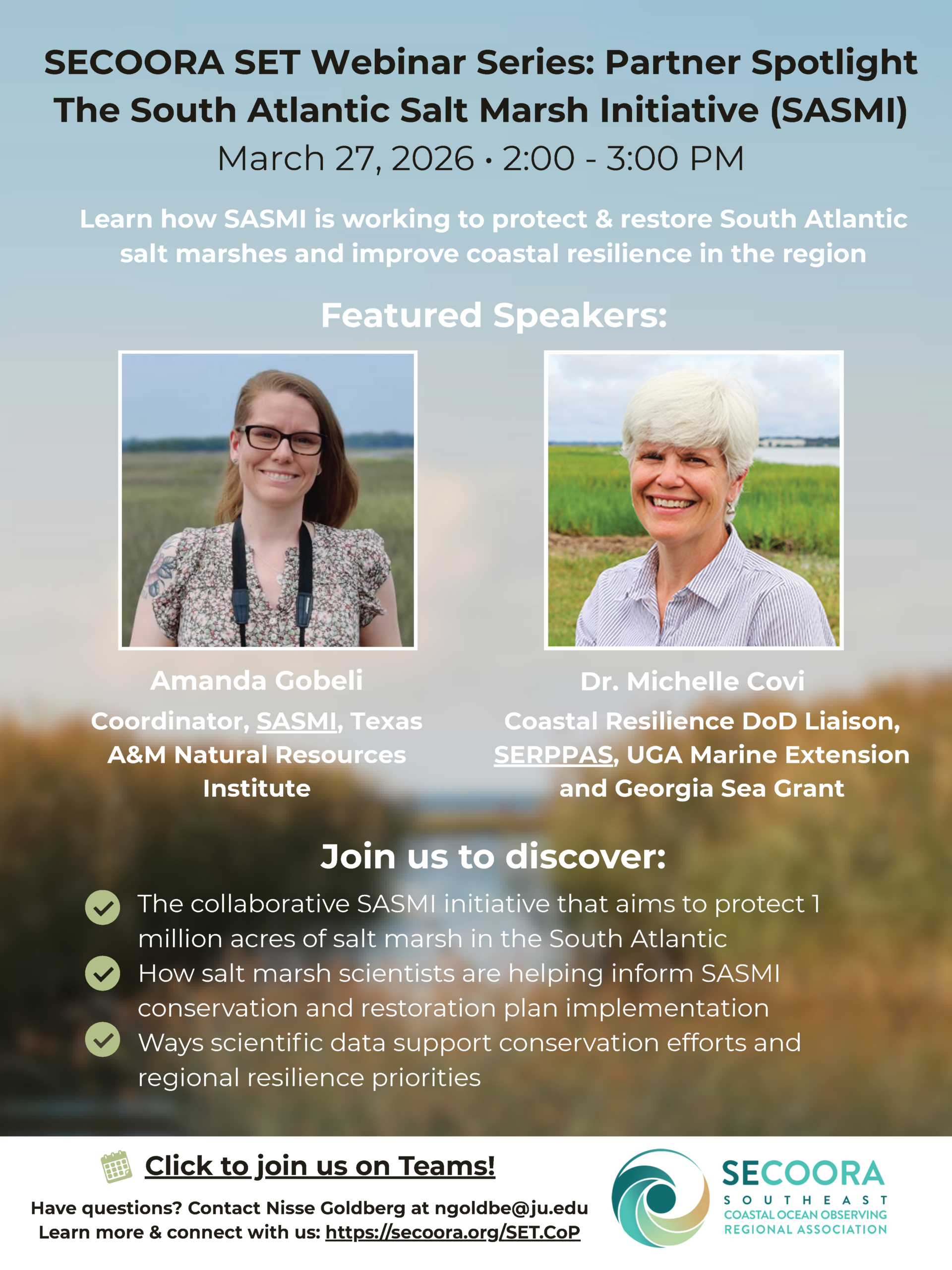
SECOORA’s Surface Elevation Table Community of Practice (SET CoP) will host an upcoming webinar spotlighting the South Atlantic Salt Marsh Initiative (SASMI) on March 27, 2026, from 2:00 – 3:00 PM (ET). This session is part of the SECOORA SET Webinar Series and will highlight regional collaboration and science-based strategies to protect and restore salt marshes across the South Atlantic.
The webinar will introduce SASMI’s coordinated, multi-partner approach to conserving one of the region’s most critical coastal ecosystems. Presenters will discuss how salt marsh science informs SASMI’s conservation and restoration planning, and how scientific data are applied to resilience planning and decision-making across conservation, military, and resource management contexts.
Speakers
- Amanda Gobeli, Coordinator, South Atlantic Salt Marsh Initiative (SASMI), Texas A&M Natural Resources Institute
- Dr. Michelle Peppina Covi, Coastal Resilience Department of Defense Liaison, Southeast Regional Partnership for Planning and Sustainability (SERPPAS), UGA Marine Extension and Georgia Sea Grant
Topics will include:
- SASMI’s regional vision, coalition framework, and 10-year goal to protect one million acres of salt marsh
- The role of scientific data in guiding marsh conservation, restoration, and resilience strategies
- Opportunities to align local, regional, and sector-specific priorities
The session will also feature discussion on how SET networks can connect with SASMI’s regional strategy, followed by an open Q&A.
Related news

SECOORA Welcomes Program Coordinator, MacEva Wright, for Resilience Program
SECOORA welcomes MacEva as our new Southeast and Caribbean Disaster Resilience Partnership (SCDRP) Program Coordinator. She will engage SCDRP members, help shape SCDRP initiatives, and create continued opportunities for regional collaboration.

Satellites Track White Marlin on the Run
Eight hooked, seven tagged, and a race deep offshore. See what satellite tags reveal about the white marlin’s life history.
Fish and Ships: Standardizing Marine eDNA Surveillance
Standardization across the eDNA metabarcoding workflow—from field sampling to laboratory sequencing and bioinformatics—is rapidly transforming marine observation.