

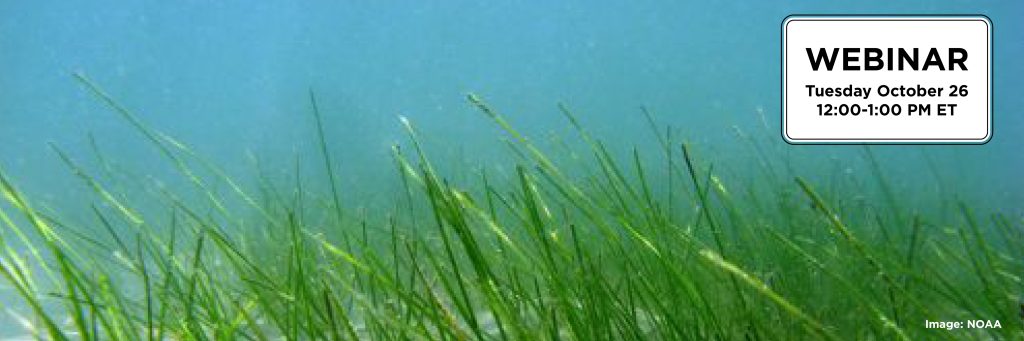
Join SECOORA for a webinar titled “It’s hot! How temperature is impacting Spotted Seatrout and seagrass in Florida Bay” on October 26 at noon ET presented by Jonathan Rodemann, Florida International University Ph.D. Candidate.
Jonathan will present preliminary results from a study investigating how temperature drives Spotted Seatrout space use within Florida Bay. Click here to reserve your spot.
Understanding the drivers of animal movement and space use is highly valuable for an appreciation of ecosystem functioning, the provisioning of services, and how to best conserve threatened ecosystems. This is especially true for recreational sportfish in coastal ecosystems, some of the most productive yet anthropogenically degraded ecosystems of the world.
Florida Bay, the largest estuary in Florida, has consistently experienced anthropogenic alteration and degradation since the development of the South Florida canal system in the mid-1900’s. This includes 2 large-scale seagrass die-offs, one in the late 1980’s and one in 2015. It also supports a large recreational sportfishing industry valued at $239 million a year. However, despite the ecological and economic importance of recreational sportfish, the impact of the seagrass die-offs on recreational sportfish movement and space use has never been examined.
Jonathan Rodemann and his team in the Coastal Fisheries Lab at Florida International University are investigating the drivers of Spotted Seatrout space use within Florida Bay. Specifically, they are interested in how temperature drives space use and whether space use is based on temperature, habitat composition, or habitat configuration. This webinar presents preliminary findings from this study.
Click here to reserve your spot for the October 26, 12 PM ET webinar.
Click here to download the flyer.
About the Presenter

Jonathan Rodemann is a 4th year PhD student in the Coastal Fisheries lab at Florida International University. He obtained a Bachelor’s degree in Marine Science from University of Miami and a Master’s degree in Marine Science from Northeastern University. His research interests include seascape and movement ecology, focusing on combining the two to determine how the structure and composition of underwater habitats affect movement and habitat use of fish. His current project looks at how the legacies of a large-scale seagrass die-off impact both the seascape structure and space use of recreational sportfishes in north central Florida Bay.
Click here to reserve your spot for the October 26, 12 PM ET webinar.
Related news
SECOORA is Hiring a Grants Manager
SECOORA is hiring a Grants Manager to lead grant and subaward management across a four-state coastal ocean observing network. Based in the Southeast US. Apply now.

Meet the new 2026 SECOORA Board Members
SECOORA welcomes three new members to its Board of Directors, effective July 1, 2026 - bringing fresh expertise in marine science, coastal geomorphology, and ecosystem restoration to guide our work across the Southeast.
SECOORA Co-Hosts the 2026 WebCOOS Workshop In Person in La Jolla, CA
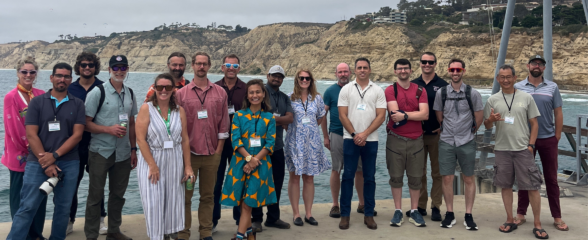
The 2026 WebCOOS Workshop convened in person on July 21-22, 2026 in La Jolla, CA. 45 attendees representing all 11 IOOS Regional Associations and national partners joined this collaborative workshop to discuss webcam-derived coastal products, stakeholder needs, and the network's transition into its next phase under IRA T2.