

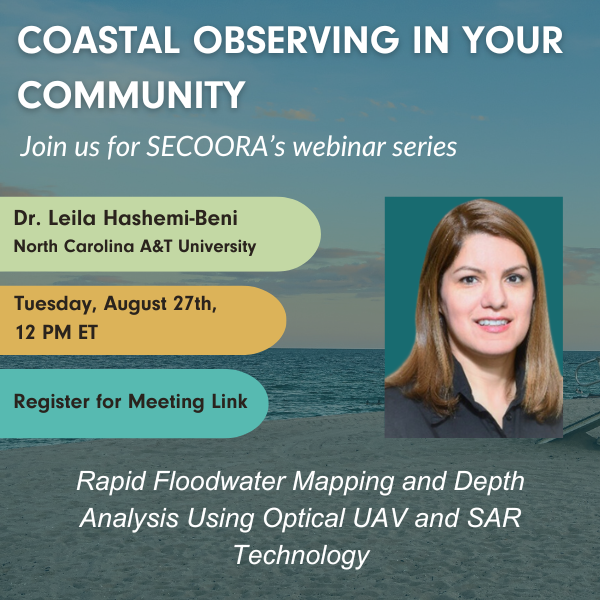
SECOORA’s August installment of the Coastal Observing in Your Community Webinar Series will feature Dr. Leila Hashemi-Beni, North Carolina Agricultural and Technical State University (NC A&T). She will provide an overview of rapid floodwater mapping and depth analysis using optical UAV and SAR technology.
This webinar is Tuesday, August 27th at 12 PM ET. Please click the button below to register for the webinar and access the meeting link. We will send a calendar invitation shortly after registration is submitted.
Webinar Abstract
Dr. Hashemi-Beni’s presentation will discuss harnessing geospatial data science and remote sensing data fusion for flood mapping. The need for fast processing and classification of massive remote sensing datasets for near real-time monitoring of floods and other rapidly changing events makes a compelling argument for integrating deep learning methods into sensing approaches to create fast and accurate flood maps. These maps can provide crucial information for delineating flood-affected areas, assessing damage (e.g., roads, bridges, infrastructures), and feeding models that predict the vulnerability of inland and coastal areas to flooding.
Speaker Bio
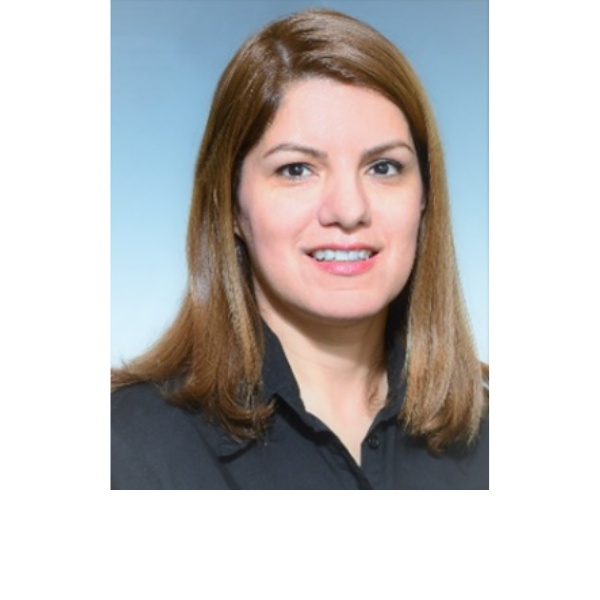
Dr. Leila Hashemi-Beni is an associate professor of Remote Sensing and GIS at the Dept. of Built Environment at College of Science and Technology, NC A&T State University. She’s the director of NCAT’s DEAP Institute of Geospatial Data Science and Remote Sensing for Environmental Management funded by NASA. She works as a PI/Co-PI on many projects supported by NASA, NSF, NOAA, Microsoft, North Carolina Collaboratory, North Carolina DoT. She is the Co-Chair of LiDAR, Laser Altimetry and Sensor Integration Working Group, International Society of Photogrammetry & Remote Sensing (ISPRS).
Related news
SECOORA is Hiring a Grants Manager
SECOORA is hiring a Grants Manager to lead grant and subaward management across a four-state coastal ocean observing network. Based in the Southeast US. Apply now.

Meet the new 2026 SECOORA Board Members
SECOORA welcomes three new members to its Board of Directors, effective July 1, 2026 - bringing fresh expertise in marine science, coastal geomorphology, and ecosystem restoration to guide our work across the Southeast.
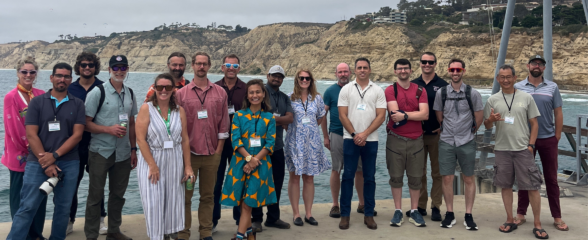
SECOORA Co-Hosts the 2026 WebCOOS Workshop In Person in La Jolla, CA
The 2026 WebCOOS Workshop convened in person on July 21-22, 2026 in La Jolla, CA. 45 attendees representing all 11 IOOS Regional Associations and national partners joined this collaborative workshop to discuss webcam-derived coastal products, stakeholder needs, and the network's transition into its next phase under IRA T2.