

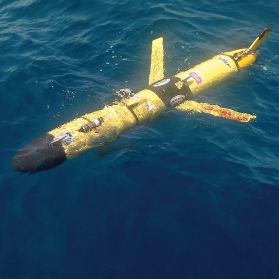
Pictured is an example of one of the technologies used to observe the ocean. It is an underwater glider with sensors that can measure ocean properties such as water temperature, chlorophyll a, salinity and more. Image Credit: USF CMS
SECOORA (Southeast Coastal Ocean Observing Regional Association) received $4.15 million in federal funding to monitor and interpret changes in coastal weather, sea-levels, and water quality in the Southeast U.S. If you listen to weather reports, boat, fish, swim, live or work along the coast, it’s likely you’ve made use of some of the data collected by SECOORA and our partners funded through this NOAA grant. SECOORA invests in ocean observing to support the marine economy, increase ocean safety, and study the environment. Observing is a word that coastal scientists use to describe various monitoring activities. This funding cycle marks the 5th year of a 5-year cooperative agreement with the U.S. Integrated Ocean Observing System (IOOS®).
Data from SECOORA are critical for operations like search and rescue, harmful algal bloom forecasting, maritime transportation, and severe weather forecasting. For example, meteorologists at the National Weather Service (NWS) use SECOORA data to create and verify weather forecasts. These data are critical to NWS forecasters as evidenced by the level of concern when COVID-19 impacted buoy operations off Charleston harbor.
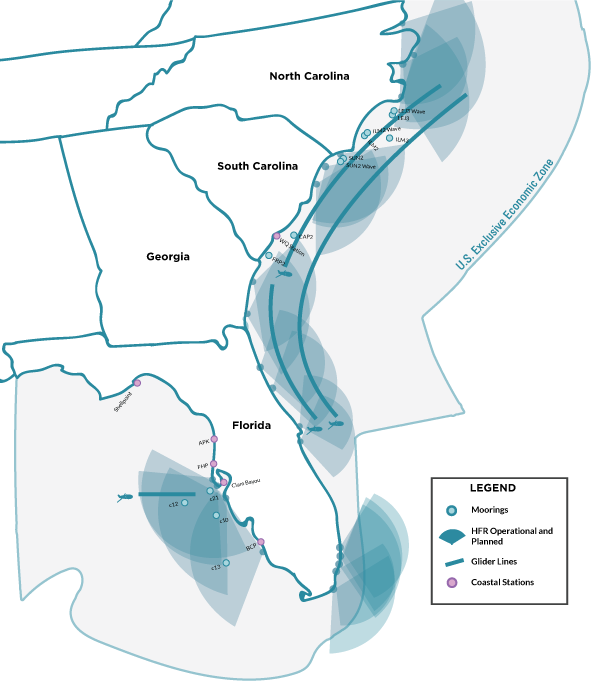
SECOORA operates over 40 observing platforms including moored and coastal stations, high-frequency radars, and a glider observatory. SECOORA also supports modeling and product development to inform coastal, ocean, and atmospheric forecasts.
Headquartered in Charleston, South Carolina, SECOORA operates over 40 observing platforms including moored and coastal stations, high-frequency radars, and a glider observatory. SECOORA is the eyes on the ocean off the coasts of Florida, Georgia, South Carolina and North Carolina. SECOORA also supports modeling and product development to inform coastal, ocean, and atmospheric forecasts. These investments are in coordination with over twenty-two partner organizations in the Southeast, from academia, to the private sector, to federal and state government partners.
“SECOORA is focused on the coastal ocean in the Southeast — collecting data and creating tools that support coastal economies and a healthy, sustainable environment. We partner with decision makers to make sure the data and tools support those living and working in the Southeast.” says Debra Hernandez, Director of SECOORA. “SECOORA is grateful for the continued funding support to sustain and expand our observing system.”
Expanding Observing
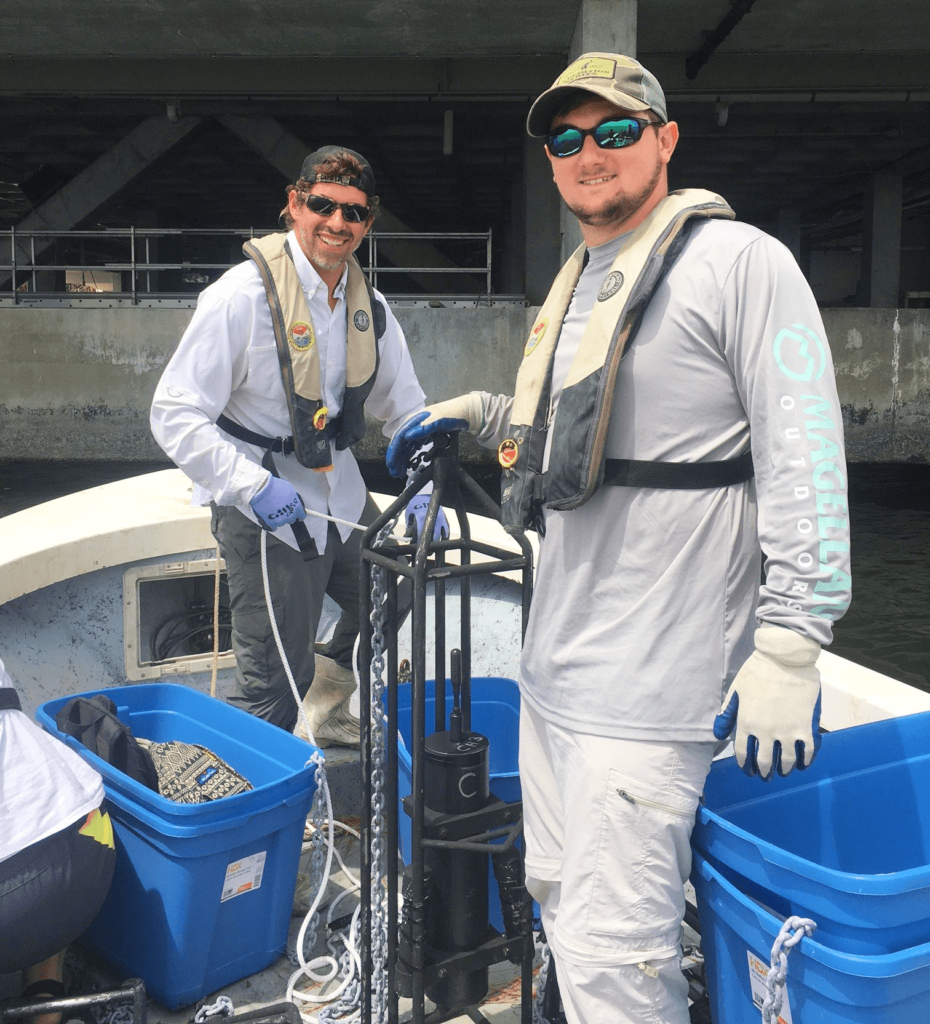
Lead scientists on the project, Eric Montie (left), and his field manager Bradshaw McKinney deploying an acoustic recorder in the Charleston Harbor.
This year, SECOORA will fund new biology research in Southeast estuarine systems. Passive acoustic technologies are being added to monitoring networks. Soundscape data, which records the noise in the ocean, allows scientists to ‘eavesdrop’ on key behaviors of marine animals that can change rapidly or gradually in response to environmental changes and human impacts. Baseline soundscape data will provide a measure of resilience or shifting baselines in a globally changing environment for economically important or protected species. This work is funded in partnership with National Oceanographic Partnership Program and US IOOS.
In collaboration with many institutions, SECOORA will continue to coordinate glider deployments during hurricane season to capture water column information ahead of hurricanes and tropical storms. Data from gliders allows forecasters and scientists to improve predictions of the storm’s potential intensity.
Contributing to National Network
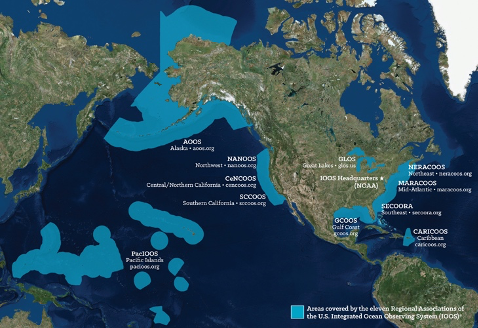
SECOORA is one of eleven regional associations of the U.S. Integrated Ocean Observing System.
Over $39 million was awarded this year across the U.S. IOOS. Regional associations coordinate local coastal and ocean observing and decision-support projects to address community needs that integrate into a comprehensive national system.
Related news

Above the High Tide: Water Level Sensors on the Front Line
SECOORA's Southeast Water Level Network has installed 100+ sensors across the Carolinas, Georgia, and Florida, giving communities real-time flood data.
SECOORA is Hiring a Grants Manager
SECOORA is hiring a Grants Manager to lead grant and subaward management across a four-state coastal ocean observing network. Based in the Southeast US. Apply now.

Meet the new 2026 SECOORA Board Members
SECOORA welcomes three new members to its Board of Directors, effective July 1, 2026 - bringing fresh expertise in marine science, coastal geomorphology, and ecosystem restoration to guide our work across the Southeast.